Vermilion snapper
Rhomboplites aurorubens · Beeliners, b-liners, mingo
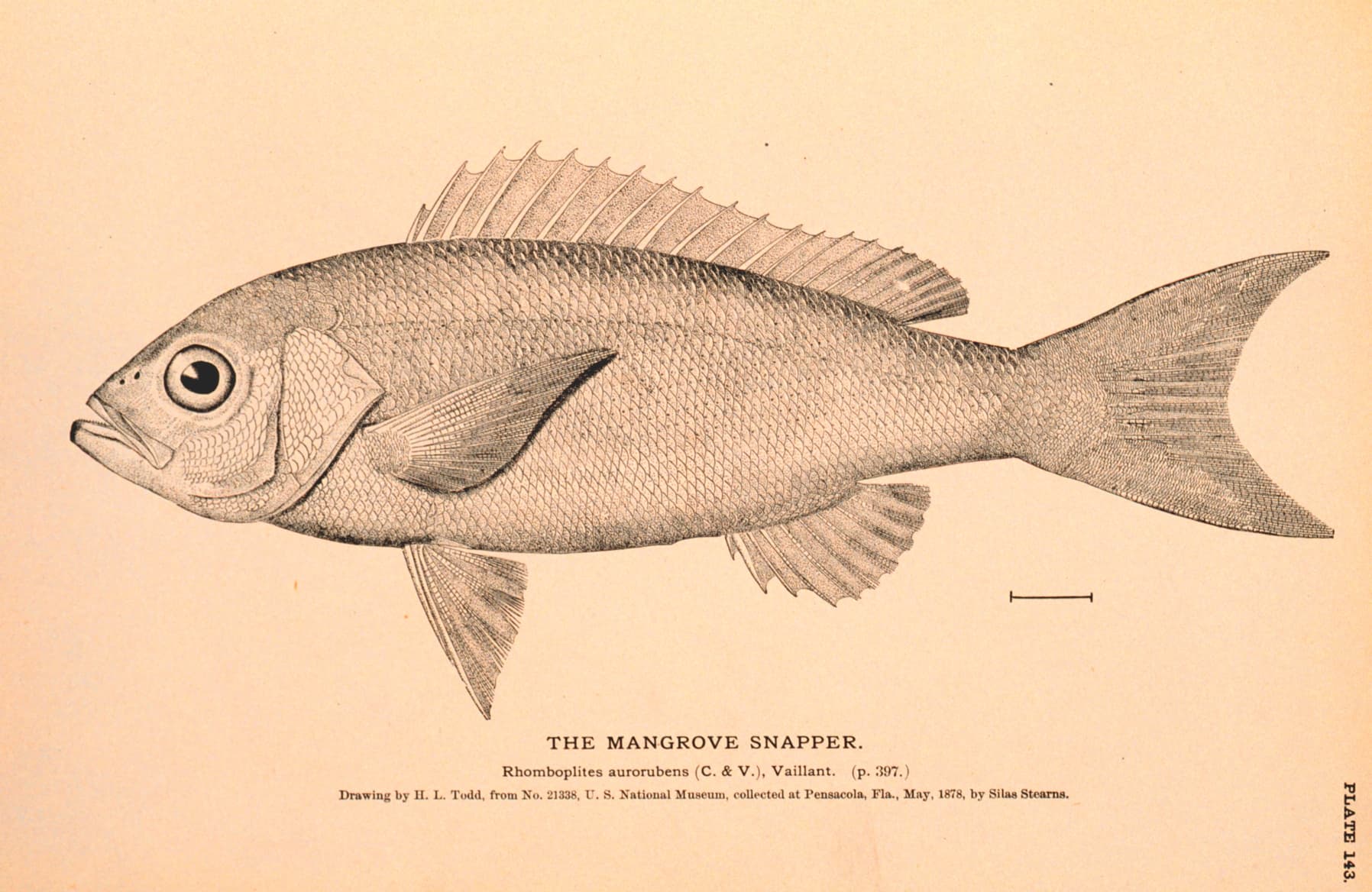
The fish that fills the box when the red snapper season is closed. Vermilion school over the banks and rigs in 150–400 ft, bite small baits all year, and have no Texas bag limit. They're a light-tackle, many-hooks fish: find the school on the sounder, drop a dropper rig fast through the current, and fill a cooler with the best-eating fish on the rigs. A spot that holds beeliners almost always holds amberjack too.
October: PeakA top target with red snapper closed in many years; bank tops and rig bases.
Texas and federal rules · Checked Oct 22, 2026
- Daily bag
- No Texas bag · federal: part of the 20-fish reef-fish aggregate
- Size
- 10 in minimum
- Season
- Open all year
Non-stainless circle hooks with natural bait and a dehooking device aboard in federal waters; a venting tool or rigged descending device for reef fish showing barotrauma (Texas state waters and, under the DESCEND Act, federal waters). Texas license with saltwater endorsement to land fish from state or federal waters.
Check the current rules ↗At a glance
- Best depth
- 150–400 ft; scattered to 650 ft
- Best structure
- Bank tops and the level bottom around rigs
- Season
- All year; best in the cooler months
- Bait
- Small squid strips, cut cigar minnow, Sabiki bait
- Rig
- Two-hook dropper with 2/0–4/0 hooks
How to identify them
- Bright vermilion to orange-red, slimmer than a red snapper, with a smaller mouth and a short, rounded snout.
- Thin blue or blue-gold lines and streaks along the upper sides, and a yellowish cast to the lower body.
- Deeply forked tail; no dark spot on the side.
Month by month
- JanPeakPrime: schools stack on the shelf-edge banks and deeper rigs; the cold doesn't slow them.
- FebPeakSame: fish the calm days between fronts; small baits, fast drops.
- MarGoodGood on the banks; spring winds make the windows short.
- AprGoodSteady on the banks and rigs in 150–400 ft.
- MayGoodA good bycatch on snapper and AJ trips; target them deeper.
- JunGoodSummer: fish the deeper end of the range and early in the day.
- JulGoodCalm seas make the deep banks easy to reach; fish the bank tops.
- AugGoodSame; a light-tackle fill-in on long runs.
- SepGoodSchools tighten up again as the water cools.
- OctPeakA top target with red snapper closed in many years; bank tops and rig bases.
- NovPeakPrime cool-water bite on the banks and reefed rigs.
- DecPeakGood whenever the weather allows a run to 150 ft+.
What 44 years of shelf surveys show
Every summer and fall since 1982, NOAA and the Gulf states' SEAMAP survey has towed the same kind of trawl across the shelf off Texas and western Louisiana. These charts are what 12,537 of those tows caught. Trawls work open, soft bottom, not the rigs and banks, and catch mostly smaller fish, so they show where along the shelf and at what depth vermilion snapper are common, not what's on a given rig.
Survey tows
12,537
1982–2025, summer and fall
Tows that caught vermilion snapper
6%
715 tows
Most per tow
180–240 ft
0.03 kg per hectare towed
Catch by depth
Average kilograms per hectare towed, all years. Hover or tab to a depth band for the number of tows.
- 0–60 ft0.00 kg/ha
- 60–120 ft0.00 kg/ha
- 120–180 ft0.02 kg/ha
- 180–240 ft0.03 kg/ha
- 240–300 ft0.02 kg/ha
- 300–400 ft0.02 kg/ha
Show the numbers
| Depth | kg per hectare | Tows | Tows with vermilion snapper |
|---|---|---|---|
| 0–60 ft | 0.00 | 2,427 | 5 |
| 60–120 ft | 0.00 | 4,841 | 87 |
| 120–180 ft | 0.02 | 2,281 | 243 |
| 180–240 ft | 0.03 | 1,570 | 273 |
| 240–300 ft | 0.02 | 1,080 | 92 |
| 300–400 ft | 0.02 | 327 | 15 |
Year by year
Average kilograms per hectare towed each year. The last ten years averaged about 2.7 times the first ten.
Show the numbers
| Year | kg per hectare |
|---|---|
| 1982 | 0.00 |
| 1983 | 0.00 |
| 1984 | 0.05 |
| 1985 | 0.00 |
| 1986 | 0.00 |
| 1987 | 0.01 |
| 1988 | 0.00 |
| 1989 | 0.00 |
| 1990 | 0.01 |
| 1991 | 0.01 |
| 1992 | 0.00 |
| 1993 | 0.02 |
| 1994 | 0.02 |
| 1995 | 0.01 |
| 1996 | 0.01 |
| 1997 | 0.01 |
| 1998 | 0.00 |
| 1999 | 0.02 |
| 2000 | 0.00 |
| 2001 | 0.01 |
| 2002 | 0.02 |
| 2003 | 0.03 |
| 2004 | 0.01 |
| 2005 | 0.01 |
| 2006 | 0.01 |
| 2007 | 0.01 |
| 2008 | 0.02 |
| 2009 | 0.01 |
| 2010 | 0.02 |
| 2011 | 0.01 |
| 2012 | 0.01 |
| 2013 | 0.01 |
| 2014 | 0.01 |
| 2015 | 0.01 |
| 2016 | 0.00 |
| 2017 | 0.02 |
| 2018 | 0.06 |
| 2019 | 0.05 |
| 2020 | 0.00 |
| 2021 | 0.01 |
| 2022 | 0.02 |
| 2023 | 0.03 |
| 2024 | 0.03 |
| 2025 | 0.02 |
On the Offshore map, the Survey biomass overlay shows each 0.1° patch of shelf against other water of the same depth, and the same survey nudges the vermilion snapper scores. Data: SEAMAP Gulf groundfish trawl survey, Gulf States Marine Fisheries Commission.
Where to find them
Shelf-edge banks
The natural banks off Port Aransas (Baker, Aransas, Hospital, Southern) and the banks off the upper coast hold the most beeliners. Fish the tops and the shoulders where the sounder shows a cloud of small fish just off the bottom.
Rigs and reefed rigs in 150–400 ft
The level bottom around the base of a rig, not the legs themselves. High Island and Mustang Island reefed rigs in 250–300 ft hold good schools.
What the shelf survey shows
SEAMAP's trawls (below) catch vermilion mostly from about 120 ft out, and the model finds the best shelf water by comparing each cell with others of the same depth. Use the Survey biomass overlay on the Offshore map to see which stretches of the shelf hold more.
How to catch them
The drop
Vermilion school a few feet to a few dozen feet off the bottom. Get the bait down fast through the current with enough lead to hold, stop it just above the bottom, and reel up a few turns. When you find the depth they're at, put every line there.
Baits
Small: strips of squid, cut cigar minnow or Spanish sardine about the size of your thumbnail. Bait you catch on a Sabiki at the rig works too. Big baits only catch the red snapper and triggerfish.
Rig and tackle
A two-hook dropper (chicken rig) with 2/0–4/0 circle hooks (non-stainless with natural bait), 30–50 lb braid for feel in deep water, a medium rod with a soft tip, and enough lead to hold bottom. An electric reel helps on the deep banks.
Reading the conditions
Current
Strong current makes the light rigs hard to keep in the school; go heavier on the lead, or fish the down-current side of the bank where the school drifts.
Temperature
Beeliners take a wide range of temperatures at depth, so the surface reading matters less than for pelagics. They bite all year.
Seas
The good banks are 30–100+ miles out; the season is set by weather windows, not by the fish.
Tips from the water
- Mark the school before you drop; a cloud of small fish over the bank top is the sign.
- Small baits, small hooks, fast drops.
- Release the shorts with a descending device: deep-water vermilion suffer barotrauma like red snapper.
- If you mark beeliners, drop a live one's worth of bait (a blue runner) for the amberjack below them.
Common mistakes
- Fishing red-snapper-sized baits and hooks over a vermilion school.
- Dropping right onto the rig legs instead of the open bottom around them.
- Too little lead in current, so the rig drifts out of the school.
Handling and release
Vermilion are among the best-eating fish offshore: ice them right away. Shorts go back down on a descending device; deep fish vented or tossed back often float off.
Use it today
- Best vermilion snapper spots right now
- How to find fish offshore
- Conditions and Gulf seas today
- Moon & weather
- Fishing reports
By port: Sabine · Bolivar · Galveston · Freeport · Sargent · Matagorda · Port O'Connor · Rockport · Port Aransas · Corpus Christi · Port Mansfield · South Padre
Sources (4)
Other species
Regulations change: confirm bag and size limits in the TPWD Outdoor Annual and with NOAA Fisheries (federal waters) before you keep a fish. Not for navigation.