Sheepshead
Archosargus probatocephalus · Convict fish, bait stealers, sheepies

The structure fish: anywhere there are barnacles, there are sheepshead. They crowd the jetties, pilings, bulkheads and rock walls all winter, spawn around the passes in late winter and early spring, and bite so delicately that catching them is a skill. Firm, white fillets make them one of the best eating fish on the coast once you learn to clean them.
October: FairPier and jetty fishing improves with every front.
TPWD rules · Sep 1, 2026 – Aug 31, 2027
- Daily bag
- 5 per day
- Size
- 15 inch minimum
- Season
- Open all year
Check the current TPWD listing; sheepshead has had the same 5-fish, 15-inch rule for years.
Check the current TPWD listing ↗At a glance
- Best months
- Dec–Apr; Feb–Mar for the spawning schools at the jetties and passes
- Water temp
- 50–75 °F is prime; present all year on structure
- Tide
- Slack to light current around pilings; moving water at the jetty ends and passes
- Structure
- Jetties, bridge and pier pilings, bulkheads, rock groins, oyster-encrusted anything
- Bait
- Fiddler crabs, live or fresh-dead shrimp, sea lice, barnacles and oysters scraped from the pilings
How to identify them
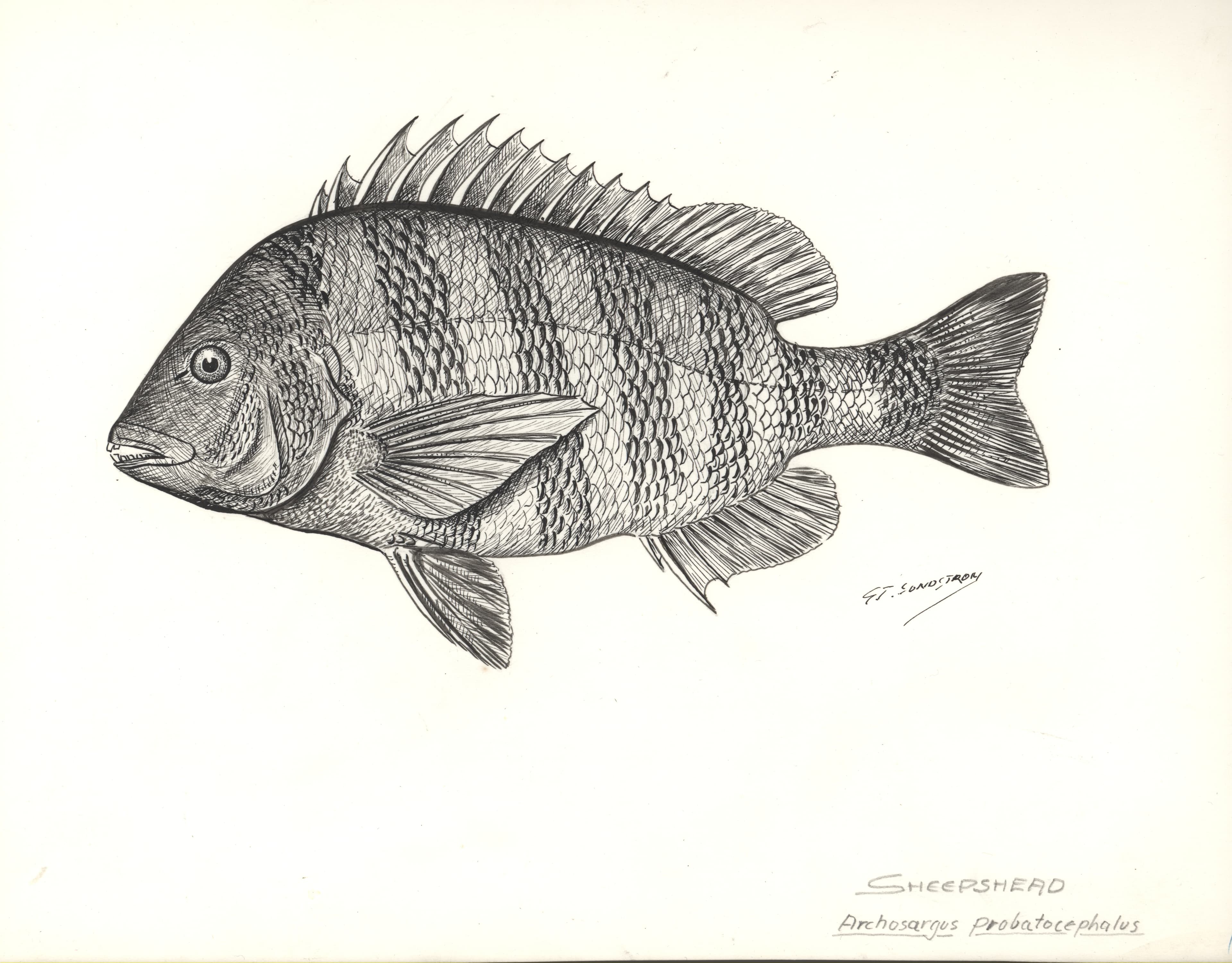
- Five to seven black vertical bars on a silvery-gray body, which is why they're called convict fish.
- Human-looking front teeth, with rows of molars behind them for crushing barnacles, crabs and oysters.
- Stout, sharp spines in the dorsal and anal fins; handle them with care.
- No chin barbels: a barred fish with whiskers is a young black drum.
Month by month
- JanGoodStacked on jetties, piers and bulkheads; fiddlers and shrimp on light tackle.
- FebPeakSpawning schools gather at the passes and jetty ends; the biggest fish of the year.
- MarPeakPeak: every rock and piling near a pass holds fish; nearshore rigs and wrecks too.
- AprGoodSpawn ends; fish spread back along the jetties, causeways and bay structure.
- MayFairPilings and rock groins in the bays; mixed with drum and reds on shell.
- JunFairSummer fish on the shady side of pilings and under the piers.
- JulFairDeeper rock at the jetties, nearshore wrecks and rigs.
- AugFairSame; dawn and late evening on the structure.
- SepFairFall cooling pulls fish back to the jetties and causeways.
- OctFairPier and jetty fishing improves with every front.
- NovGoodWinter pattern sets in; bulkheads and bridges in the ICW hold schools.
- DecGoodGood everywhere there is barnacle-covered structure; small hooks, light line.
What 38 years of survey nets show
Every spring and fall since 1982, Texas Parks and Wildlife biologists have set the same overnight gill nets along the shorelines of every bay system from Sabine Lake to the Lower Laguna Madre, to track the fish. These charts are what 26,981 of those nets caught (1982–2019). Catch per net compares places, seasons and years; it isn't a count of fish.
Survey nets
26,981
1982–2019, spring and fall
Nets that caught sheepshead
36%
9,818 nets
Most per net lately
Lower Laguna Madre
2.7 per net, 2010–2019
Catch per net by bay system
2010–2019, spring and fall averaged. Nets catch more in murky water than clear, so treat close numbers as ties. Hover or tab to a bay for each season.
- Lower Laguna Madre2.7
- San Antonio Bay2.3
- Upper Laguna Madre2.0
- Aransas Bay1.8
- Corpus Christi Bay1.6
- Matagorda Bay1.0
- Galveston Bay0.59
- Sabine Lake0.20
Show the numbers
| Bay system | Spring 2010–2019 | Fall 2010–2019 | Spring 1982–2019 | Fall 1982–2019 | Nets |
|---|---|---|---|---|---|
| Lower Laguna Madre | 2.9 | 2.6 | 2.2 | 2.2 | 3,408 |
| San Antonio Bay | 2.4 | 2.1 | 2.4 | 2.3 | 3,419 |
| Upper Laguna Madre | 1.9 | 2.1 | 1.00 | 1.0 | 3,418 |
| Aransas Bay | 1.1 | 2.4 | 1.2 | 2.0 | 3,420 |
| Corpus Christi Bay | 1.7 | 1.4 | 1.9 | 0.97 | 3,420 |
| Matagorda Bay | 1.2 | 0.85 | 1.2 | 0.99 | 3,418 |
| Galveston Bay | 0.62 | 0.55 | 0.53 | 0.52 | 3,420 |
| Sabine Lake | 0.19 | 0.20 | 0.20 | 0.21 | 3,058 |
Coastwide, year by year
Average catch per net across the bay systems, spring and fall.
The 1984 and 1990 drops followed the December 1983 and December 1989 freezes, which killed fish across the Texas bays.
Show the numbers
| Year | Spring | Fall |
|---|---|---|
| 1982 | 2.5 | 2.0 |
| 1983 | 2.9 | 2.1 |
| 1984 | 1.6 | 0.71 |
| 1985 | 0.78 | 0.61 |
| 1986 | 0.53 | 0.97 |
| 1987 | 0.68 | 1.1 |
| 1988 | 0.67 | 0.91 |
| 1989 | 0.90 | 1.2 |
| 1990 | 0.86 | 0.49 |
| 1991 | 0.50 | 0.51 |
| 1992 | 0.78 | 0.77 |
| 1993 | 0.57 | 0.86 |
| 1994 | 0.46 | 1.0 |
| 1995 | 1.6 | 1.2 |
| 1996 | 1.8 | 1.2 |
| 1997 | 1.4 | 1.6 |
| 1998 | 1.6 | 1.6 |
| 1999 | 1.3 | 1.3 |
| 2000 | 1.8 | 1.6 |
| 2001 | 1.4 | 1.3 |
| 2002 | 1.4 | 1.9 |
| 2003 | 2.3 | 1.8 |
| 2004 | 1.2 | 1.4 |
| 2005 | 1.5 | 1.4 |
| 2006 | 1.2 | 1.1 |
| 2007 | 1.3 | 1.0 |
| 2008 | 1.1 | 1.2 |
| 2009 | 1.4 | 1.3 |
| 2010 | 0.93 | 1.4 |
| 2011 | 1.5 | 2.1 |
| 2012 | 1.6 | 2.3 |
| 2013 | 1.8 | 1.6 |
| 2014 | 2.1 | 1.4 |
| 2015 | 2.0 | 1.4 |
| 2016 | 1.4 | 0.97 |
| 2017 | 1.1 | 1.4 |
| 2018 | 1.4 | 1.0 |
| 2019 | 1.2 | 1.6 |
Salinity
Catch compared with the average at each salinity, with place and season accounted for. Most sheepshead came from 25–35 ppt water (shaded).
Show the numbers
| Salinity (ppt) | Catch vs average | Nets |
|---|---|---|
| 0 | 77% | 1,213 |
| 2.5 | 85% | 749 |
| 5 | 93% | 1,233 |
| 7.5 | 94% | 933 |
| 10 | 95% | 1,415 |
| 12.5 | 99% | 1,066 |
| 15 | 101% | 1,732 |
| 17.5 | 101% | 1,215 |
| 20 | 102% | 1,714 |
| 22.5 | 104% | 1,392 |
| 25 | 108% | 2,259 |
| 27.5 | 112% | 1,890 |
| 30 | 115% | 2,415 |
| 32.5 | 117% | 1,976 |
| 35 | 112% | 2,147 |
| 37.5 | 100% | 1,185 |
| 40 | 93% | 962 |
| 42.5 | 95% | 350 |
| 45 | 96% | 355 |
Water temperature
Catch compared with the average at each temperature, with place and season accounted for. Most came from 66–77°F water (shaded).
Show the numbers
| Water (°F) | Catch vs average | Nets |
|---|---|---|
| 66 | 115% | 437 |
| 68 | 108% | 597 |
| 70 | 108% | 810 |
| 72 | 112% | 1,124 |
| 73 | 113% | 1,503 |
| 75 | 111% | 1,873 |
| 77 | 107% | 2,297 |
| 79 | 104% | 2,729 |
| 81 | 95% | 2,883 |
| 82 | 84% | 2,974 |
| 84 | 81% | 2,985 |
| 86 | 84% | 2,850 |
| 88 | 88% | 1,872 |
| 90 | 90% | 885 |
When young sheepshead show up
Small sheepshead per bag-seine haul along the shoreline, by month (2002–2016). Most in Jun.
Show the numbers
| Month | Per haul |
|---|---|
| Jan | 0.00 |
| Feb | 0.00 |
| Mar | 0.01 |
| Apr | 0.03 |
| May | 0.05 |
| Jun | 0.33 |
| Jul | 0.12 |
| Aug | 0.08 |
| Sep | 0.06 |
| Oct | 0.04 |
| Nov | 0.03 |
| Dec | 0.01 |
Survey hot spots on our map
Spots where the survey model expects the most sheepshead per net (2010–2019 average). The live scores use this as one factor, next to today's water, wind and tide.
Spring (Apr–Jun)
- 1.Decros Point (Matagorda Bay)9.8
- 2.Laguna Vista Shoreline (Lower Laguna Madre)8.9
- 3.Lydia Ann Channel (Port Aransas)7.9
- 4.Mustang Point / Ship Channel (Port Aransas)7.6
- 5.Matagorda Ship Channel Jetties (Port O'Connor)5.3
- 6.South Bay (Port Aransas)5.1
Fall (Sep–Nov)
- 1.Dewberry Island (Espiritu Santo Bay)7.8
- 2.Los Corrales (Baffin Bay)5.9
- 3.Dagger Island (Redfish Bay)5.7
- 4.Mustang Point / Ship Channel (Port Aransas)5.6
- 5.Lydia Ann Channel (Port Aransas)5.4
- 6.Bowie Park area (Lower Laguna Madre)5.4
Numbers: expected sheepshead per survey net.
Sources: TPWD gill net survey and bag seine survey (Texas Parks and Wildlife Coastal Fisheries, archived at BCO-DMO). Salinity, temperature and hot spots come from a model trained on these nets and checked on survey years it never saw; it ranks places inside a bay with a correlation of 0.85 on those years. Nets are set in spring and fall only, so summer and winter aren't sampled.
Where to find them
Jetties and groins
All the Gulf jetties and the Galveston Seawall groins: fish straight down the rocks, in the gaps between boulders, and on the channel side where the rocks are deepest. In February and March the spawning schools gather at the ends and in the washouts.
Pilings, bridges and causeways
The Texas City Dike, Seawolf Park, Pelican Island bridge, the Galveston Causeway, the Surfside and Matagorda bridges, the Copano and Port Aransas causeways, the JFK Causeway, the Queen Isabella Causeway. Fish tight to the piling, on the up-current side, a few feet off the bottom.
Bulkheads, docks and rock walls
Marina seawalls, canal bulkheads, oyster-covered dock pilings, riprap along channels and the ICW. Anywhere you can see barnacles at low tide holds sheepshead at high tide.
Nearshore rigs, wrecks and reefs
Within state waters, the standing rigs and the TPWD artificial reefs hold big sheepshead in winter and spring; fish the legs and the structure edge with a dropper rig.
How to catch them
Bait
Fiddler crabs are the classic (hook through the back edge of the shell so the point comes out the top); live shrimp with the tail broken off and the hook through the meat; sea lice; pieces of fresh-dead shrimp; oysters or barnacles scraped off a piling and tied on with thread. Small baits on small, strong hooks.
Rig and the bite
A #1–1/0 strong short-shank hook (or a 1/8–1/4 oz jig head) on 20–25 lb fluorocarbon, a split shot or a light dropper weight just enough to hold near the bottom, and a tight line. The bite is a tap or a slight weight; sheepshead crush the bait with their teeth before they swallow it. Keep the line tight and set the hook the instant the rod tip loads.
Chumming
Scrape barnacles off the pilings or rocks with a hoe or shovel so they fall into the water, and the fish gather under you. Crushed oysters and a mesh bag of shrimp heads work too.
Tackle
A 7' medium rod with a sensitive tip, braid for feel, fluorocarbon leader for abrasion around rock and barnacles. Fish vertically whenever possible; casting away from the structure is wasted time. A long-handled net or a hand gaff is useful at the jetty.
Reading the conditions
Tide
Around pilings and bulkheads, slack water and the first of the moving tide let you keep the bait right on the structure; at the jetty ends and passes, moving water brings the spawning schools up the rocks.
Clarity
Clear water helps: sheepshead feed by sight and you often see them turn on the bait. Dirty water after a blow slows the bite; fish the channel side of the jetty or the inside of a causeway where it clears first.
Temperature and season
Any time from December to April is good, and the spawning push in February and March, when the water starts to warm from the 50s, concentrates the biggest fish at the passes.
Wind
Fish the lee side of the structure; a piling bridge lets you choose. On a windy day, the bay-side causeways and bulkheads are the comfortable choice.
Tips from the water
- Set the hook on anything. The old saying is to set the hook just before the bite; it is not far wrong.
- Fish straight down, tight to the structure, with just enough weight to feel the bottom.
- Small hook, fresh bait, tight line: the three rules.
- Look for them before you fish; in clear water you can see the black bars against pilings and rocks.
- Bring a glove and a heavy knife or electric fillet knife for cleaning; the scales and rib bones are tough.
- Spawning aggregations in March are vulnerable; take what you'll eat and leave the big females.
Common mistakes
- Big hooks and heavy leaders; sheepshead see them and ignore the bait.
- Waiting for a solid pull that never comes.
- Casting out away from the structure.
- Fishing the windward, muddy side of the jetty when the other side is clear.
Handling and release
Watch the dorsal spines and the teeth. Lip grips don't work; hold them behind the head with a towel. They release well. Fillets are excellent and the carcass makes good stock.
Use it today
By port: Sabine · Bolivar · Galveston · Freeport · Sargent · Matagorda · Port O'Connor · Rockport · Port Aransas · Corpus Christi · Port Mansfield · South Padre
Other species
Regulations change: confirm bag and size limits in the TPWD Outdoor Annual before you keep a fish. Not for navigation.