Redfish
Sciaenops ocellatus · Red drum, reds, slot reds; a tail-spot fish on the flats is a tailer

The most dependable fish on the Texas coast. Slot reds (20–28 inches) live shallow, eat almost anything, pull like a fish twice their size and bite in weather that shuts trout down. They tail on the flats on a rising tide, crush shrimp along the shorelines in fall, and stack in the back lakes before fronts. If the wind is up and the water is dirty, go redfishing.
October: PeakPeak month everywhere: back lakes draining on fronts, shorelines, reefs; topwaters all day.
TPWD rules · Sep 1, 2026 – Aug 31, 2027
- Daily bag
- 3 per day (possession 6)
- Size
- 20–28 inch slot
- Season
- Open all year
One red over 28 inches per license year with a completed Red Drum Tag, plus one more with a Bonus Red Drum Tag. See the bull redfish guide for the oversize run.
Check the current TPWD listing ↗At a glance
- Best months
- Sep–Nov is the peak; good all year
- Water temp
- 55–88 °F; still feeds in the 50s on sunny afternoons
- Tide
- Rising tide on the flats and shorelines; falling tide at drains and marsh mouths
- Wind
- Tolerates wind better than trout; the windward shoreline where bait is pinned is often best
- Depth
- 6 inches to 6 feet most of the year; deep channels in cold snaps
How to identify them
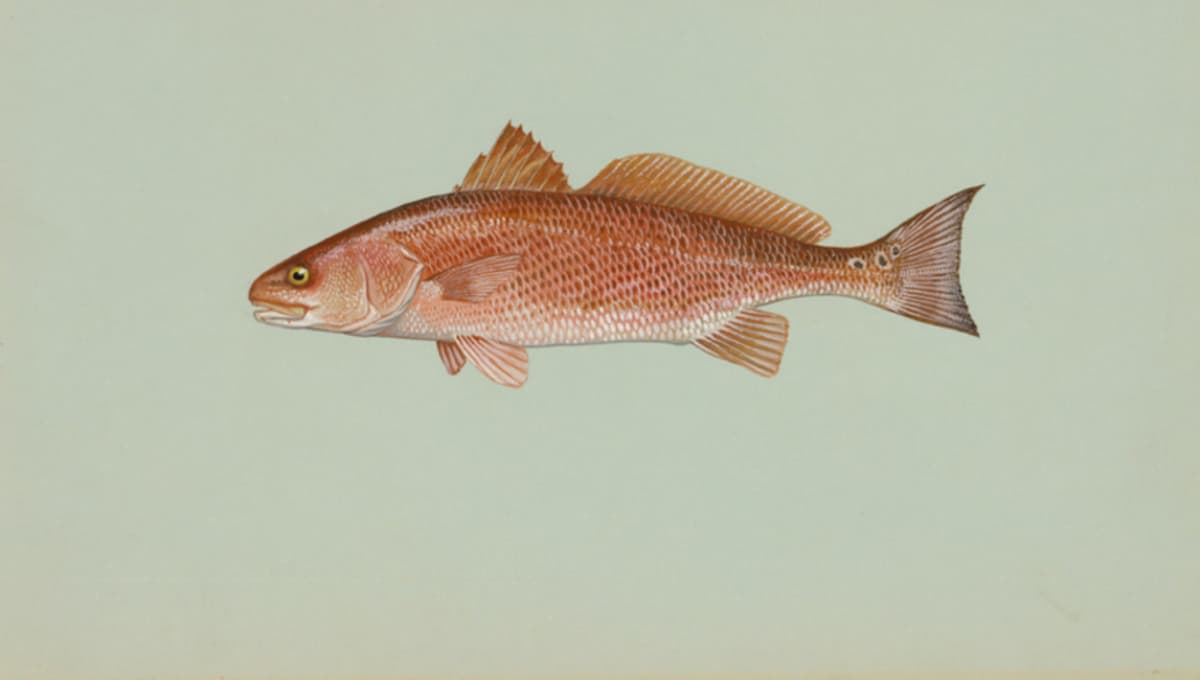
- Copper to bronze back fading to a white belly. Bay fish run darker; fish from the Gulf are paler and more brassy.
- One or more black spots at the base of the tail. Most have one, some have dozens, and a few have none.
- Blunt nose and an underslung mouth for rooting on the bottom, and no chin barbels, which tells a small red from a black drum.
Month by month
- JanFairDeep bayous, channel edges and the ICW; sunny afternoons bring them onto dark mud flats to warm.
- FebFairSame deep water, plus the first warm-up tailing on the Laguna and Baffin flats.
- MarGoodSpring tides flood the marsh; fish the shorelines and drains as the water rises.
- AprGoodShrimp return; corks on the shorelines, crabs on the reefs, sight-casting improves.
- MayGoodFlats and grass beds, oyster reef edges, back lakes on high tides.
- JunGoodEarly and late on the flats; schools on the open-bay reefs and wells by mid-morning.
- JulGoodShrimp-boat wakes in the bay, deep reef edges, jetties; tailing at daylight on the lower coast.
- AugGoodHot and steady: dawn on the flats, then the surf, jetties and passes.
- SepPeakThe fall feed begins; schools herd shrimp and mullet along shorelines; the bull run starts at the passes.
- OctPeakPeak month everywhere: back lakes draining on fronts, shorelines, reefs; topwaters all day.
- NovPeakFish gang up in the back lakes and bayous as water drops; big schools on the flats of the Laguna.
- DecGoodBetween fronts, dark-bottom flats and bayou mouths on afternoon warm-ups.
What 38 years of survey nets show
Every spring and fall since 1982, Texas Parks and Wildlife biologists have set the same overnight gill nets along the shorelines of every bay system from Sabine Lake to the Lower Laguna Madre, to track the fish. These charts are what 26,981 of those nets caught (1982–2019). Catch per net compares places, seasons and years; it isn't a count of fish.
Survey nets
26,981
1982–2019, spring and fall
Nets that caught redfish
92%
24,955 nets
Most per net lately
Sabine Lake
16 per net, 2010–2019
Catch per net by bay system
2010–2019, spring and fall averaged. Nets catch more in murky water than clear, so treat close numbers as ties. Hover or tab to a bay for each season.
- Sabine Lake16
- San Antonio Bay15
- Galveston Bay14
- Lower Laguna Madre14
- Corpus Christi Bay11
- Aransas Bay10
- Upper Laguna Madre9.3
- Matagorda Bay9.2
Show the numbers
| Bay system | Spring 2010–2019 | Fall 2010–2019 | Spring 1982–2019 | Fall 1982–2019 | Nets |
|---|---|---|---|---|---|
| Sabine Lake | 20 | 12 | 12 | 11 | 3,058 |
| San Antonio Bay | 13 | 18 | 13 | 17 | 3,419 |
| Galveston Bay | 19 | 9.6 | 14 | 9.6 | 3,420 |
| Lower Laguna Madre | 12 | 16 | 13 | 16 | 3,408 |
| Corpus Christi Bay | 11 | 11 | 11 | 11 | 3,420 |
| Aransas Bay | 9.8 | 11 | 12 | 14 | 3,420 |
| Upper Laguna Madre | 9.3 | 9.2 | 7.8 | 8.1 | 3,418 |
| Matagorda Bay | 8.8 | 9.7 | 9.0 | 9.5 | 3,418 |
Coastwide, year by year
Average catch per net across the bay systems, spring and fall.
Show the numbers
| Year | Spring | Fall |
|---|---|---|
| 1982 | 7.3 | 6.3 |
| 1983 | 7.8 | 6.8 |
| 1984 | 6.3 | 9.2 |
| 1985 | 5.5 | 12 |
| 1986 | 9.3 | 10 |
| 1987 | 8.3 | 9.8 |
| 1988 | 9.1 | 11 |
| 1989 | 7.9 | 9.0 |
| 1990 | 7.0 | 9.9 |
| 1991 | 6.7 | 14 |
| 1992 | 15 | 14 |
| 1993 | 14 | 15 |
| 1994 | 12 | 11 |
| 1995 | 10 | 8.9 |
| 1996 | 18 | 11 |
| 1997 | 13 | 15 |
| 1998 | 15 | 14 |
| 1999 | 9.4 | 11 |
| 2000 | 8.5 | 14 |
| 2001 | 11 | 12 |
| 2002 | 11 | 16 |
| 2003 | 13 | 14 |
| 2004 | 14 | 14 |
| 2005 | 12 | 14 |
| 2006 | 12 | 13 |
| 2007 | 16 | 15 |
| 2008 | 12 | 13 |
| 2009 | 15 | 12 |
| 2010 | 16 | 15 |
| 2011 | 13 | 15 |
| 2012 | 15 | 12 |
| 2013 | 12 | 9.2 |
| 2014 | 14 | 11 |
| 2015 | 12 | 12 |
| 2016 | 11 | 10 |
| 2017 | 9.0 | 11 |
| 2018 | 12 | 11 |
| 2019 | 13 | 14 |
Salinity
Catch compared with the average at each salinity, with place and season accounted for. Catch barely changes with salinity: redfish take almost any bay water.
Show the numbers
| Salinity (ppt) | Catch vs average | Nets |
|---|---|---|
| 0 | 101% | 1,213 |
| 2.5 | 102% | 749 |
| 5 | 101% | 1,233 |
| 7.5 | 101% | 933 |
| 10 | 102% | 1,415 |
| 12.5 | 102% | 1,066 |
| 15 | 103% | 1,732 |
| 17.5 | 102% | 1,215 |
| 20 | 101% | 1,714 |
| 22.5 | 99% | 1,392 |
| 25 | 97% | 2,259 |
| 27.5 | 97% | 1,890 |
| 30 | 97% | 2,415 |
| 32.5 | 97% | 1,976 |
| 35 | 98% | 2,147 |
| 37.5 | 100% | 1,185 |
| 40 | 100% | 962 |
| 42.5 | 100% | 350 |
| 45 | 102% | 355 |
Water temperature
Catch compared with the average at each temperature, with place and season accounted for. Most came from 66–72°F water (shaded).
Show the numbers
| Water (°F) | Catch vs average | Nets |
|---|---|---|
| 66 | 115% | 437 |
| 68 | 113% | 597 |
| 70 | 112% | 810 |
| 72 | 109% | 1,124 |
| 73 | 103% | 1,503 |
| 75 | 99% | 1,873 |
| 77 | 98% | 2,297 |
| 79 | 96% | 2,729 |
| 81 | 93% | 2,883 |
| 82 | 90% | 2,974 |
| 84 | 89% | 2,985 |
| 86 | 89% | 2,850 |
| 88 | 93% | 1,872 |
| 90 | 101% | 885 |
When young redfish show up
Small redfish per bag-seine haul along the shoreline, by month (2002–2016). Most in Jan, Feb, Nov, Dec.
Show the numbers
| Month | Per haul |
|---|---|
| Jan | 0.80 |
| Feb | 1.3 |
| Mar | 0.69 |
| Apr | 0.55 |
| May | 0.31 |
| Jun | 0.23 |
| Jul | 0.20 |
| Aug | 0.12 |
| Sep | 0.15 |
| Oct | 0.23 |
| Nov | 0.85 |
| Dec | 1.3 |
Survey hot spots on our map
Spots where the survey model expects the most redfish per net (2010–2019 average). The live scores use this as one factor, next to today's water, wind and tide.
Spring (Apr–Jun)
- 1.East Pass (Sabine Lake)47
- 2.Cold Pass (Christmas / Bastrop Bay)41
- 3.San Luis Pass40
- 4.Bastrop Bay Shell (Christmas / Bastrop Bay)38
- 5.Cedar Bayou (Mesquite Bay)35
- 6.Hickory Cove (Sabine Lake)35
Fall (Sep–Nov)
- 1.Traylor Island (Redfish Bay)45
- 2.Cedar Bayou (Mesquite Bay)40
- 3.Middle Ground (West Matagorda)38
- 4.Last Chance (Aransas Bay)34
- 5.Greens Bayou (West Matagorda Bay)34
- 6.Farwell Island (Espiritu Santo Bay)33
Numbers: expected redfish per survey net.
Sources: TPWD gill net survey and bag seine survey (Texas Parks and Wildlife Coastal Fisheries, archived at BCO-DMO). Salinity, temperature and hot spots come from a model trained on these nets and checked on survey years it never saw; it ranks places inside a bay with a correlation of 0.92 on those years. Nets are set in spring and fall only, so summer and winter aren't sampled.
Where to find them
Shorelines with bait
Reds patrol the edge: grass or marsh shorelines with mullet and shrimp pinned against them by the wind. Look for V-wakes, tails, pushes and bait spraying. Cast ahead of the fish's path and let it find the bait.
Flats and potholes
The Lower Laguna, Baffin, Redfish Bay, the Lighthouse Lakes, the Galveston and Matagorda back lakes. Sand potholes in grass, the edges of oyster beds, and the drop at the edge of the flat. Tailing fish on a rising tide are feeding on crabs and shrimp in the grass.
Drains and marsh mouths
On a falling tide, especially after a front, every drain is a buffet line. Anchor or stake out off the mouth, cast up into the drain and let the bait wash out with the current.
Reefs, wells and spoil banks
Mid-bay oyster reefs, well pads and the spoil along channels hold schools in summer and on strong tides. Fish the down-current side with cut bait on the bottom.
Jetties, passes and the surf
Slot reds live around the rocks and in the surf guts all summer; from September the passes fill with oversized fish (see the bull redfish guide).
How to catch them
Natural bait
Live shrimp under a popping cork or on a jig head; cut mullet, cut menhaden or a half blue crab on a fish-finder (Carolina) rig on the bottom for schools and reef fish; finger mullet or a live croaker free-lined along shorelines. Reds feed by smell as much as sight, so cut bait on a dirty-water day is deadly.
Lures
Gold or copper weedless spoons (1/4–1/2 oz) are the classic flats lure; paddle tails and shrimp imitations on 1/8–1/4 oz jig heads; weedless soft plastics in the grass; topwaters (reds miss them often, so keep walking it); spinnerbaits and chatterbaits in off-color water. In the back lakes, a Gulp shrimp under a cork is hard to beat.
Sight-casting
Pole or wade slowly with the sun behind you. Lead a cruising fish by 3–4 ft and let the lure sit; a tailing fish needs the bait dropped a foot in front of its nose. Watch for the fish to tip down and then set the hook with a sweep.
Fly
Redfish are the Texas fly fish: 8-weight, floating line, 9–10 ft leader to 16–20 lb tippet, crab and shrimp patterns, spoon flies and small poppers in the fall.
Tackle
7' medium rod, 3000 spinning reel or baitcaster, 15–20 lb braid, 25–30 lb fluorocarbon leader; 30–40 lb around shell and pilings. Circle hooks (4/0–6/0) for cut bait.
Reading the conditions
Wind
Wind pins bait against a shoreline and muddies the water, which reds don't mind. A windward bank with 10–15 kt onshore and bait in the suds is a redfish shoreline. Over 20 kt, fish the back lakes and the lee shores.
Tide and water level
Water level matters more than the tide table in Texas: three days of south wind puts a foot of water on the flats and reds go into the marsh; a north wind drains it and they fall back into the drains and bayous. Check the observed-vs-predicted level on the tide pages.
Water temperature
Comfortable from the mid-50s to the high 80s. In cold snaps they hold in deep bayous and channels and feed on sunny afternoons over dark mud. In summer heat they feed early and in the deeper, cooler water by midday.
Fronts
The day before a front, and the first falling-tide after it, are the best redfish days of the fall: everything in the marsh comes out at once.
Clarity
Clean enough to sight-cast is a bonus, not a requirement. In dirty water, fish cut bait, rattles, dark plastics and gold spoons, and slow down.
Tips from the water
- Look for signs before you cast: tails, wakes, mud boils, bait spraying, pelicans and gulls diving on a shoreline, slicks.
- Be quiet. Reds in shallow water spook from a trolling motor, a dropped pliers or a hull slap; drift, pole or wade the last 100 yards.
- Fish the shoreline with the wind at your back when you can: longer casts and the bait is on that bank.
- In fall, follow the shrimp: when the back lakes drain, work the drains, then the bayou, then the bay shoreline below it.
- A school on an open flat will spook from a boat; set up ahead of its direction of travel and let it come to you.
- Gold spoons with a small swivel and a loop knot cast farther and twist less.
Common mistakes
- Casting at the fish instead of ahead of it.
- Fishing the back lakes on a low, falling tide when the fish have already left for the drains.
- Running the trolling motor at high speed across a shallow flat.
- Leaving a school that stops biting; change bait or color before you change spots.
Handling and release
Support the belly for photos and hold the fish horizontally. Reds are tough and release well; revive one that fought long by holding it into the current until it kicks. Measure slot fish carefully with the tail pinched; 28 inches comes quickly in the fall.
Use it today
By port: Sabine · Bolivar · Galveston · Freeport · Sargent · Matagorda · Port O'Connor · Rockport · Port Aransas · Corpus Christi · Port Mansfield · South Padre
Other species
Regulations change: confirm bag and size limits in the TPWD Outdoor Annual before you keep a fish. Not for navigation.