Bull redfish
Sciaenops ocellatus (oversize red drum, 28 in and up) · Bull reds, breeders, big uglies
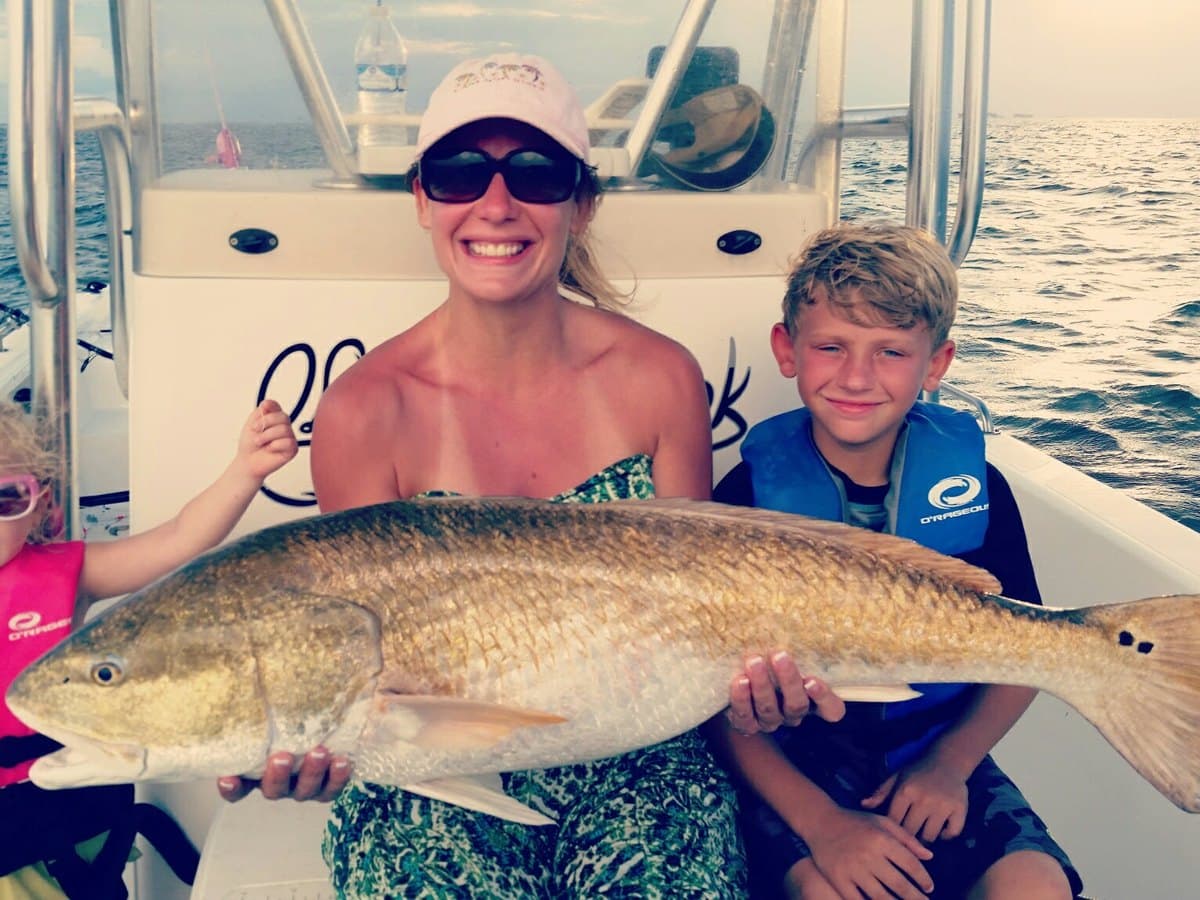
From late August into December, mature red drum gather at the passes, jetties and the beachfront to spawn, and the biggest fish of the year become reachable from a boat, a jetty rock or the sand. A 40-inch red in a tide-ripped pass on 20-pound tackle is the toughest fight the bays offer. These are the breeding stock: one over-28 fish per year on your tag, and the rest go back in good shape.
October: PeakPeak. Schools of 100+ fish at the jetties and in the surf; birds and slicks give them away.
TPWD rules · Sep 1, 2026 – Aug 31, 2027
- Daily bag
- Counts within the red drum bag of 3, but only fish 20–28 inches may be kept without a tag
- Size
- Over 28 inches: one per license year with the Red Drum Tag, one more with the Bonus Red Drum Tag
- Season
- Open all year; the run is Sep–Dec
Digital tags must be reported in the Texas Hunt & Fish app before the fish is moved. Many anglers never use the tag; a 40-inch red is 15–30 years old.
Check the current TPWD listing ↗At a glance
- Best months
- Mid-Sep to mid-Nov at the passes; Oct is the peak
- Where
- Jetties, passes, channels, the surf guts and the bay side of the passes
- Tide
- The strongest tides of the month, especially the outgoing in the evening
- Wind
- Light to moderate; a big southeast swell makes the jetties dangerous
- Bait
- Cut mullet, whole or half blue crab, cracked crab, live mullet, menhaden
How to identify them
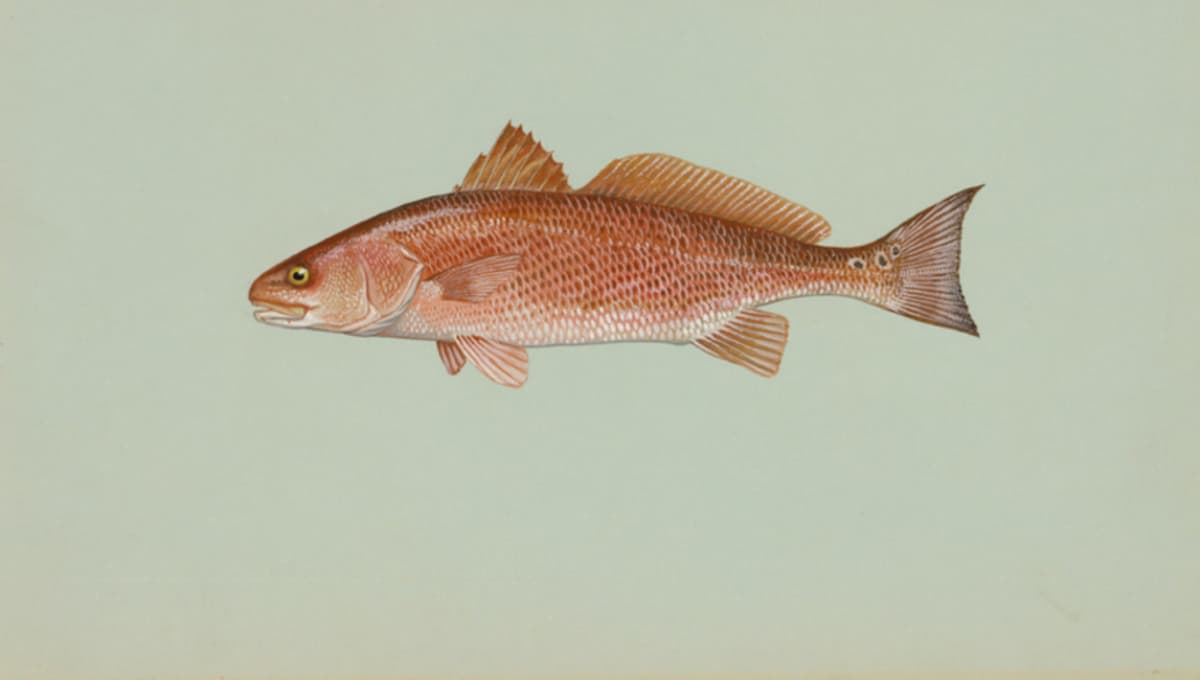
- The same fish as a slot red, grown up: anything over 28 inches. Most fall-run bulls are 30 to 40-plus inches.
- Paler and more brassy than bay reds, with the same black tail spot (sometimes several, sometimes none).
- A black drum the same size is deeper and taller, gray to black, with barbels under the chin.
Month by month
- JanFairStragglers at the jetties and in the deep channels; schools offshore along the beach.
- FebSlowDeep channel holes and the nearshore Gulf; mostly a by-catch while drum fishing.
- MarSlowScattered big fish around the jetties and nearshore rigs.
- AprSlowBeachfront and jetty fish on calm days; shark anglers see them.
- MayFairSurf schools begin to show on calm mornings; the first guts at daylight.
- JunFairJetties and the surf on light wind; the bay side of the passes at night.
- JulFairSurf and jetties; big fish follow the menhaden schools along the beach.
- AugGoodThe run begins late in the month: passes and jetties on strong evening tides.
- SepPeakFull swing: every pass from Sabine to Brazos Santiago, the surf, the channels behind the jetties.
- OctPeakPeak. Schools of 100+ fish at the jetties and in the surf; birds and slicks give them away.
- NovGoodStill strong through mid-month; fish spread into the ship channels and the bay side of the passes.
- DecFairTapering; the deep holes near the passes and the beachfront on warm, calm days.
What 38 years of survey nets show
Every spring and fall since 1982, Texas Parks and Wildlife biologists have set the same overnight gill nets along the shorelines of every bay system from Sabine Lake to the Lower Laguna Madre, to track the fish. These charts are what 26,981 of those nets caught (1982–2019). Catch per net compares places, seasons and years; it isn't a count of fish. Bull reds spend most of their lives in the Gulf, outside these bay nets, so these numbers are for redfish of all sizes.
Survey nets
26,981
1982–2019, spring and fall
Nets that caught redfish
92%
24,955 nets
Most per net lately
Sabine Lake
16 per net, 2010–2019
Catch per net by bay system
2010–2019, spring and fall averaged. Nets catch more in murky water than clear, so treat close numbers as ties. Hover or tab to a bay for each season.
- Sabine Lake16
- San Antonio Bay15
- Galveston Bay14
- Lower Laguna Madre14
- Corpus Christi Bay11
- Aransas Bay10
- Upper Laguna Madre9.3
- Matagorda Bay9.2
Show the numbers
| Bay system | Spring 2010–2019 | Fall 2010–2019 | Spring 1982–2019 | Fall 1982–2019 | Nets |
|---|---|---|---|---|---|
| Sabine Lake | 20 | 12 | 12 | 11 | 3,058 |
| San Antonio Bay | 13 | 18 | 13 | 17 | 3,419 |
| Galveston Bay | 19 | 9.6 | 14 | 9.6 | 3,420 |
| Lower Laguna Madre | 12 | 16 | 13 | 16 | 3,408 |
| Corpus Christi Bay | 11 | 11 | 11 | 11 | 3,420 |
| Aransas Bay | 9.8 | 11 | 12 | 14 | 3,420 |
| Upper Laguna Madre | 9.3 | 9.2 | 7.8 | 8.1 | 3,418 |
| Matagorda Bay | 8.8 | 9.7 | 9.0 | 9.5 | 3,418 |
Coastwide, year by year
Average catch per net across the bay systems, spring and fall.
Show the numbers
| Year | Spring | Fall |
|---|---|---|
| 1982 | 7.3 | 6.3 |
| 1983 | 7.8 | 6.8 |
| 1984 | 6.3 | 9.2 |
| 1985 | 5.5 | 12 |
| 1986 | 9.3 | 10 |
| 1987 | 8.3 | 9.8 |
| 1988 | 9.1 | 11 |
| 1989 | 7.9 | 9.0 |
| 1990 | 7.0 | 9.9 |
| 1991 | 6.7 | 14 |
| 1992 | 15 | 14 |
| 1993 | 14 | 15 |
| 1994 | 12 | 11 |
| 1995 | 10 | 8.9 |
| 1996 | 18 | 11 |
| 1997 | 13 | 15 |
| 1998 | 15 | 14 |
| 1999 | 9.4 | 11 |
| 2000 | 8.5 | 14 |
| 2001 | 11 | 12 |
| 2002 | 11 | 16 |
| 2003 | 13 | 14 |
| 2004 | 14 | 14 |
| 2005 | 12 | 14 |
| 2006 | 12 | 13 |
| 2007 | 16 | 15 |
| 2008 | 12 | 13 |
| 2009 | 15 | 12 |
| 2010 | 16 | 15 |
| 2011 | 13 | 15 |
| 2012 | 15 | 12 |
| 2013 | 12 | 9.2 |
| 2014 | 14 | 11 |
| 2015 | 12 | 12 |
| 2016 | 11 | 10 |
| 2017 | 9.0 | 11 |
| 2018 | 12 | 11 |
| 2019 | 13 | 14 |
Salinity
Catch compared with the average at each salinity, with place and season accounted for. Catch barely changes with salinity: redfish take almost any bay water.
Show the numbers
| Salinity (ppt) | Catch vs average | Nets |
|---|---|---|
| 0 | 101% | 1,213 |
| 2.5 | 102% | 749 |
| 5 | 101% | 1,233 |
| 7.5 | 101% | 933 |
| 10 | 102% | 1,415 |
| 12.5 | 102% | 1,066 |
| 15 | 103% | 1,732 |
| 17.5 | 102% | 1,215 |
| 20 | 101% | 1,714 |
| 22.5 | 99% | 1,392 |
| 25 | 97% | 2,259 |
| 27.5 | 97% | 1,890 |
| 30 | 97% | 2,415 |
| 32.5 | 97% | 1,976 |
| 35 | 98% | 2,147 |
| 37.5 | 100% | 1,185 |
| 40 | 100% | 962 |
| 42.5 | 100% | 350 |
| 45 | 102% | 355 |
Water temperature
Catch compared with the average at each temperature, with place and season accounted for. Most came from 66–72°F water (shaded).
Show the numbers
| Water (°F) | Catch vs average | Nets |
|---|---|---|
| 66 | 115% | 437 |
| 68 | 113% | 597 |
| 70 | 112% | 810 |
| 72 | 109% | 1,124 |
| 73 | 103% | 1,503 |
| 75 | 99% | 1,873 |
| 77 | 98% | 2,297 |
| 79 | 96% | 2,729 |
| 81 | 93% | 2,883 |
| 82 | 90% | 2,974 |
| 84 | 89% | 2,985 |
| 86 | 89% | 2,850 |
| 88 | 93% | 1,872 |
| 90 | 101% | 885 |
When young redfish show up
Small redfish per bag-seine haul along the shoreline, by month (2002–2016). Most in Jan, Feb, Nov, Dec.
Show the numbers
| Month | Per haul |
|---|---|
| Jan | 0.80 |
| Feb | 1.3 |
| Mar | 0.69 |
| Apr | 0.55 |
| May | 0.31 |
| Jun | 0.23 |
| Jul | 0.20 |
| Aug | 0.12 |
| Sep | 0.15 |
| Oct | 0.23 |
| Nov | 0.85 |
| Dec | 1.3 |
Survey hot spots on our map
Spots where the survey model expects the most redfish per net (2010–2019 average). The live scores use this as one factor, next to today's water, wind and tide.
Spring (Apr–Jun)
- 1.East Pass (Sabine Lake)47
- 2.Cold Pass (Christmas / Bastrop Bay)41
- 3.San Luis Pass40
- 4.Bastrop Bay Shell (Christmas / Bastrop Bay)38
- 5.Cedar Bayou (Mesquite Bay)35
- 6.Hickory Cove (Sabine Lake)35
Fall (Sep–Nov)
- 1.Traylor Island (Redfish Bay)45
- 2.Cedar Bayou (Mesquite Bay)40
- 3.Middle Ground (West Matagorda)38
- 4.Last Chance (Aransas Bay)34
- 5.Greens Bayou (West Matagorda Bay)34
- 6.Farwell Island (Espiritu Santo Bay)33
Numbers: expected redfish per survey net.
Sources: TPWD gill net survey and bag seine survey (Texas Parks and Wildlife Coastal Fisheries, archived at BCO-DMO). Salinity, temperature and hot spots come from a model trained on these nets and checked on survey years it never saw; it ranks places inside a bay with a correlation of 0.92 on those years. Nets are set in spring and fall only, so summer and winter aren't sampled.
Where to find them
Jetties
Sabine Pass, Galveston North and South, Surfside/Quintana, Matagorda, Port O'Connor (boat), Port Aransas, Packery, Mansfield (boat) and Brazos Santiago. Fish the end of the rocks, the washouts (gaps), the channel side on an outgoing tide and the Gulf side when the surf is flat. From a boat, anchor up-current and drift baits back along the rocks.
Passes and channels
San Luis Pass, Cedar Bayou, Pass Cavallo, the Mansfield Cut, and the ship channels behind every jetty: Bolivar Roads, the Matagorda Ship Channel, Aransas Channel. The deep edge of the channel where it meets the flat is where the schools hold between feeding pushes.
The surf
The second and third guts behind the outer bar, especially at a pass mouth, a washout or in front of a beach drain. Look for diving pelicans, slicks and the school's brown shadow in a wave. Long rods and a sand spike; 4–8 oz spider weights in the current.
Bay side and reefs near the passes
Bull reds also work the bay-side flats and reefs close to the passes on the outgoing tide in October, often with slicks and birds: Bolivar Pocket, the flats inside Pass Cavallo, the Lydia Ann Channel edges.
How to catch them
Bottom rig
Fish-finder (Carolina) rig: 3–8 oz sinker (pyramid or spider weight in current, egg sinker on shell) on a slider, 50–80 lb mono or fluorocarbon leader 18–30 in, 7/0–9/0 non-offset circle hook. Half a mullet (head half), a cracked blue crab, a whole menhaden or a big chunk of ladyfish. Let the fish load the rod and reel steadily; never set a circle hook.
Free-lined and under a float
Around the jetty rocks, a live mullet or a big croaker free-lined or under a large float drifts naturally along the rocks. On the surface-feeding schools in the surf and passes, a big topwater, a 1 oz gold spoon or a 6-inch swimbait draws explosive strikes.
Tackle
7'6"–9' medium-heavy rod, 5000–8000 spinning or a conventional reel with 30–50 lb braid; 10–12 ft surf rods from the beach. A long-handled net or a lip-and-belly lift for landing; no gaffs, these fish are going back.
Finding the school
Run the beach or the channel edge at first light looking for birds, slicks, color changes and the school itself, which shows as a copper patch or a wake. In the pass, mark them on the sounder in the deep bends. When one hooks up, others are feeding: get a second bait in fast.
Reading the conditions
Tide
Spawning reds feed on the strong tides around the new and full moons; the evening outgoing after a strong flood is the classic window. Check the coefficient on the tide pages and plan around the two or three biggest days of the fortnight.
Wind and seas
The jetties fish best when the Gulf is 2 ft or less. A hard southeast blow with 4–6 ft seas washes the rocks and makes the Gulf side unfishable; move to the channel side or the bay side. North wind after a front flattens the surf and often triggers a strong bite the next day.
Water
Bull reds don't need clean water. Stained channel water with a current seam is fine; green water in the surf is a bonus mostly because it brings the schools within casting range.
Light
The last two hours of light into dark on an outgoing tide is the prime jetty window; dawn is second. Night fishing the channels with cut bait produces all fall.
Tips from the water
- Use circle hooks and keep the rod in a holder or your hands with the drag set; a bull red hooked in the jaw releases clean.
- Carry a big rubber-mesh net or a Boga-style grip plus a hand under the belly; never hang a 30-lb fish vertically.
- Have your tag question settled before the trip: most anglers release every bull. If you keep one, know the tag rules and the app.
- From the jetty, fish the washouts and the end; from the beach, fish the gut at the pass mouth; from a boat, anchor and chum with cut menhaden.
- A ladyfish or a big mullet head stays on the hook through pinfish and hardheads; shrimp gets stolen.
- When sharks move in on the jetty, move 100 yards or change tides; they follow the hooked reds.
Common mistakes
- Undersized tackle and a light drag; the fish wraps the jetty rocks or the fight lasts long enough to exhaust it.
- Letting a big fish lie on hot sand or a deck for photos; keep it in the water.
- Giving up at slack tide instead of waiting for the current to turn.
Handling and release
Minimize the fight with heavy enough tackle, keep the fish in the water for photos, support the belly, and revive it in the current until it swims off strongly. A descending or venting tool is not needed; these are shallow fish. Pinch the tail and measure before deciding anything about a tag.
Use it today
- Best bull redfish spots right now
- How to find fish on the maps
- Conditions today
- Tides
- Fishing reports
- Surf
By port: Sabine · Bolivar · Galveston · Freeport · Sargent · Matagorda · Port O'Connor · Rockport · Port Aransas · Corpus Christi · Port Mansfield · South Padre
Other species
Regulations change: confirm bag and size limits in the TPWD Outdoor Annual before you keep a fish. Not for navigation.