Swordfish
Xiphias gladius · Swords, broadbill
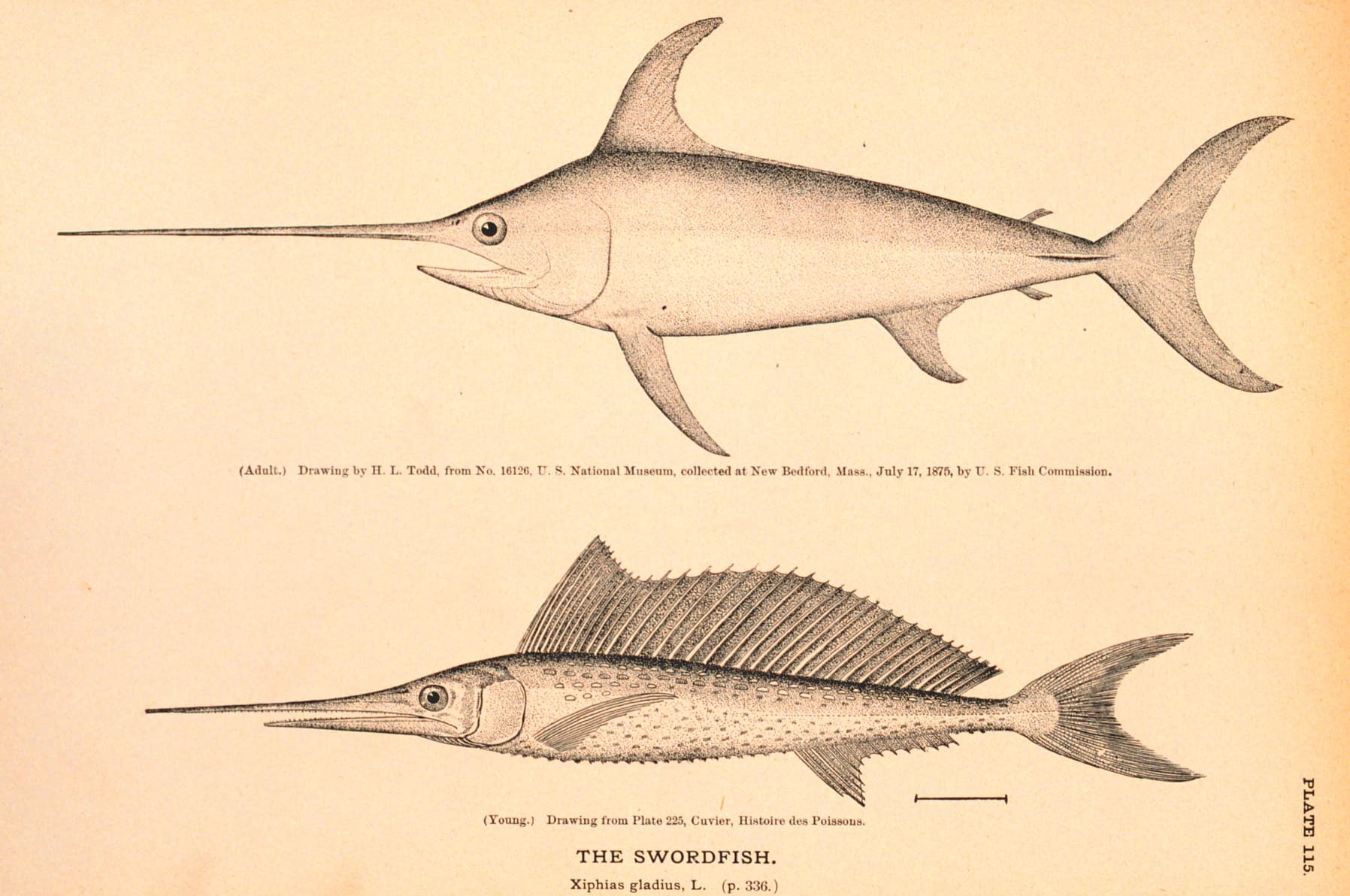
Texas is one of the best places in the country to catch a swordfish in daylight. The western Gulf's light current lets you drop a bait straight down to the walls and ledges 1,500–1,800 ft below and hold it there, a method Brett Holden and the Booby Trap team out of Freeport worked out between 2008 and 2010 and have used to release well over 1,000 swords. At night the same fish rise to within a few hundred feet of the surface and can be caught on drifted baits under lights.
October: GoodFronts shorten the windows; fish still there.
Texas and federal rules · Checked Oct 22, 2026
- Daily bag
- 1 per person, up to 4 per vessel (private); charter 6, headboat 15 per vessel
- Size
- 47 in lower-jaw fork length (or 25 in cleithrum to keel)
- Season
- Open all year
Federal HMS Angling (or Charter/Headboat) permit required. Report every landed swordfish within 24 hours (HMS Catch Reporting app, online, or 888-872-8862). No swordfish retention with a hammerhead or oceanic whitetip aboard.
Check the current rules ↗At a glance
- Run
- 70–110 mi; Freeport/Surfside 85–100+, Port Mansfield 50–70
- Daytime bottom
- 1,100–2,000 ft (Booby Trap: 1,600–1,800)
- Night baits
- 50–400 ft down; deeper under a bright moon
- Best months
- Mid-June – August; fished through September
- Current
- 1 kt or less is ideal; over ~2 kt you can't hold bottom
How to identify them
- A long, flat, broad bill (round in cross-section on marlin and sails), about a third of the body length.
- No scales or teeth as adults, no pelvic fins, and a single large keel on each side of the tail.
- Dark bronze-purple back fading to lighter sides; huge eyes for feeding deep.
Month by month
- JanFairFish are there all year; winter windows to 100-mile walls are rare.
- FebFairSame: short windows only.
- MarFairSpring winds; pick the flat days.
- AprGoodLonger calm spells start; daytime drops on the walls.
- MayGoodSquid run small (4–6 in) early in summer; good daytime fishing.
- JunPeakMid-June through August is the best of weather and fish.
- JulPeakPeak daytime sword season off Freeport and Surfside.
- AugPeakPeak; bigger squid later in summer make fish pickier.
- SepGoodFished through September; watch the tropics.
- OctGoodFronts shorten the windows; fish still there.
- NovFairShort windows.
- DecFairShort windows; night trips combined with winter wahoo at dawn.
Where to find them
Walls, ledges and canyons in 1,100–2,000 ft
Daytime swordfish feed deep, mostly 1,300–2,600 ft down (tagging studies), which off Texas puts them near the bottom along the continental slope. Most bites come right where the bottom first drops off: the top edge of a wall or ledge, canyon edges, ridges and the flanks of salt domes. The record fish (493 lb, 2013) came from 1,711 ft about 100 mi off Surfside.
Booby Trap Dome and the Hilltops
Booby Trap's daytime zone is a straight run southeast from the West Cerveza platform in about 1,700 ft; NOAA's bottom data shows a flat-topped salt dome near 27.70 N, 94.22 W with a steep west wall (probable, not confirmed). The Hilltops off the upper coast are "deepwater mountain ranges" for night drifts on the 150–300 fathom drops.
East Breaks and the south coast
From Port Aransas, the East Breaks (~73 mi) and its walls below 27.65 N in the 1,100–2,000 ft band. Port Mansfield boats drift over salt domes and deep valleys 50–70 mi out over 1,500 ft.
Night water
900–1,800 ft (150–300 fathoms) just past the shelf: the Hilltops, 130 Fathom Rock and High Spot, the deep rocks and near the deepwater floaters.
Texas spots to try
| Port | Run | Notes |
|---|---|---|
| Freeport / Surfside | 85–110 mi | Booby Trap's grounds: walls and canyons in 1,600–1,800 ft |
| Port Aransas | 70–75 mi | East Breaks ~73 mi, the Dumps ~66; floaters 130–155 mi |
| Port Mansfield | 50–70 mi | Over 1,500 ft on salt domes and deep valleys |
| Galveston / Port O'Connor / South Padre | — | Same depth band; no published run distances |
Named spots' coordinates aren't published. The Offshore map's swordfish picks and wall pins find the edges in the right depth.
How to catch them
Daytime deep drop
Idle up-current of the edge so the drift carries the bait across the top of the wall. Drop to the bottom on a breakaway weight; when it hits, the sacrificial weight pops off and the bait rides just off the bottom under the lighter top weight. Hold near the bottom, then try 100–250 ft above it where the sounder shows scattered bait. Drifts run 0.5–1 mi (about an hour): run back up and drift the same edge again before moving.
The bite
A sword often swats the bait first. Drop back about 40 ft to feed it, then come tight. When one fish feeds they all tend to feed, so stay on the same ledge.
Night drift
Spread baits through the water column (Brett Holden: 50/100/150 ft; others 100/200/300 or 50–400 ft), with a lightstick or LED above each and boat lights to draw bait. Free-spool 60–100 ft before clipping on the weight. "The brighter the moon, the deeper the baits": 200–400 ft under a full moon. Dark and quarter moons fish best.
Rigs and tackle
Day: 50W conventional or electric reel with 65–80 lb braid, a 300 lb leader (many boats run a 75–100 ft wind-on), an 11/0 hook, whole squid sewn with 70 lb floss or mahi/bonito belly strips, a 6–9 lb breakaway on the hook plus a 2–3 lb ball on a longline clip about 60 ft up, and a blue or green LED ~30 ft above the bait. About 12–15 lb of drag. Night: 50 lb class, 15–20 ft of 200–300 lb leader, 10/0–12/0 hooks.
Reading the conditions
Current
Light (1 kt or less) is ideal for the deep drop; keep the braid within about 45° of vertical. Once the top few hundred feet move 2–3 kt you can't hold bottom: make it a night trip.
Moon
At night, swords sit mostly within 250 ft under a dark moon and 330–660 ft under a full moon (tagging data). The moon matters little for the daytime drop.
Season and seas
Summer. Mid-June through August is best for weather and fish. Runs are 70–110 miles and the trips are long: wait for a window.
Eddies
Evidence is mixed: swordfish larvae peak in cold-core water, but studies disagree about adults. Don't plan a trip around an eddy.
Tips from the water
- Most bites come where the bottom first drops off: drift across the top of the wall.
- When one bites, they all bite: stay on that ledge.
- Zoom in on a swordfish pick on the Offshore map: up to three pins mark the top of the walls from NOAA's hi-res bottom, each with a drift plan.
- Pair the trip with tilefish and deep grouper on the same walls.
- Many deep rocks sit in the shipping lanes at night: lookout and lights on.
Common mistakes
- Fishing the deep drop in 2+ kt current.
- Setting the hook on the first swat instead of dropping back.
- Night baits at a single depth instead of spread through the column.
Handling and release
Swords fight hard to the end and can be dangerous at the boat; harpoon or gaff only a legal fish, and keep the bill away from people. Release under-47 in fish in the water. Report every landed swordfish within 24 hours.
Use it today
- Best swordfish spots right now
- How to find fish offshore
- Conditions and Gulf seas today
- Moon & weather
- Fishing reports
- Billfish guide
By port: Sabine · Bolivar · Galveston · Freeport · Sargent · Matagorda · Port O'Connor · Rockport · Port Aransas · Corpus Christi · Port Mansfield · South Padre
Go deeper
The billfish guide: altimetry, eddies and the marlin and sailfish models →
Sources (9)
- Marlin Magazine: Booby Trap's quest for 1,000 swordfish
- Marlin Magazine: Booby Trap squid rigging
- Salt Water Sportsman: The Gulf's swordfishing wonderland
- Texas Saltwater Fishing Magazine: Strangers in the night
- Sport Fishing: Booby Trap Dome and the Hilltops
- Outdoor Life: 493 lb Texas record swordfish
- Bass Pro 1Source: Texas swordfish breakdown
- Lerner et al. 2013: Swordfish depth by day, night and moon
- NOAA Fisheries: Atlantic swordfish sizes and limits
Other species
Regulations change: confirm bag and size limits in the TPWD Outdoor Annual and with NOAA Fisheries (federal waters) before you keep a fish. Not for navigation.