Tilefish & deep grouper
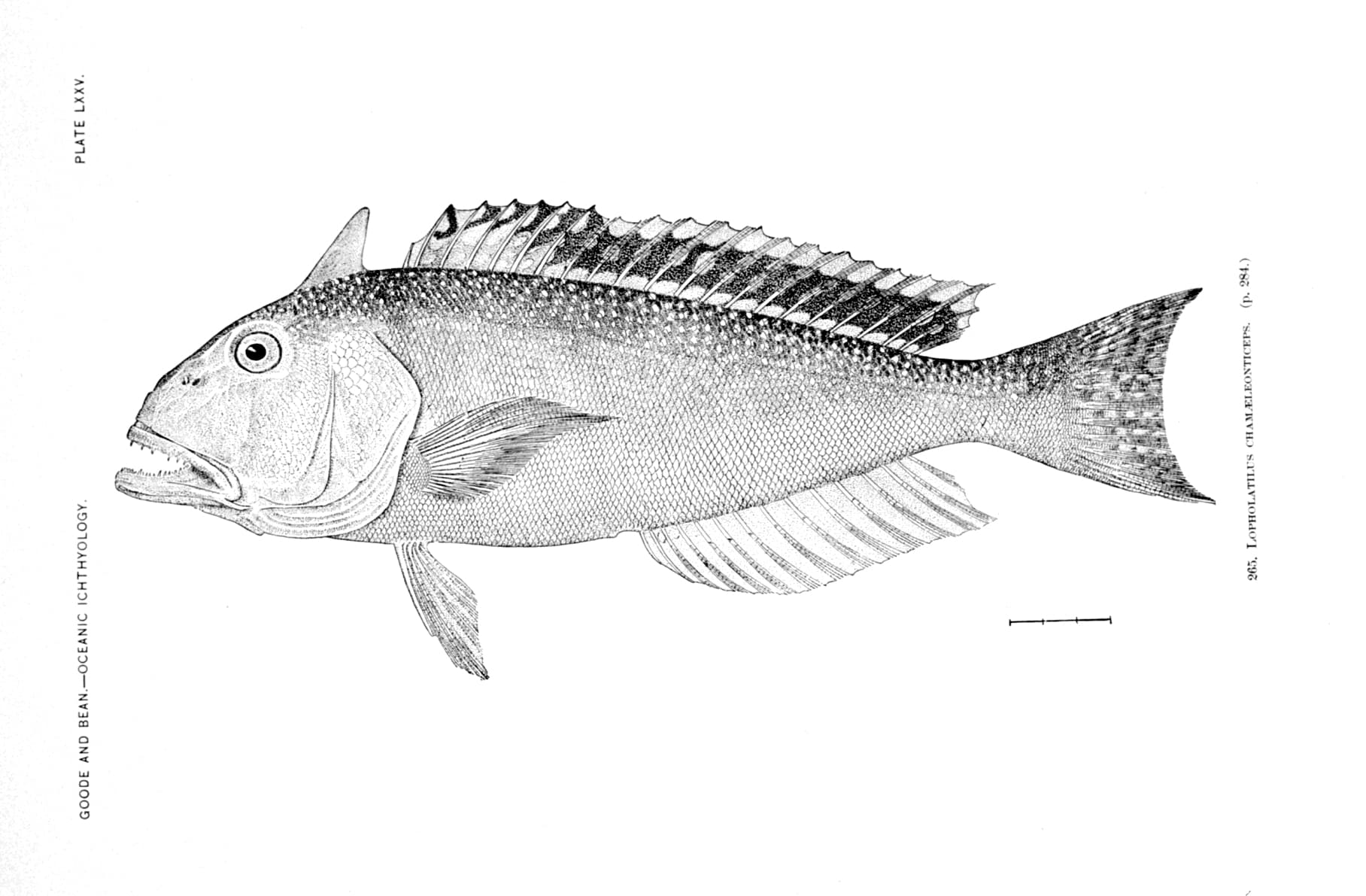
Lopholatilus chamaeleonticeps (golden tilefish), Hyporthodus flavolimbatus (yellowedge grouper) · Golden tilefish, blueline tilefish, yellowedge, warsaw and snowy grouper
Deep dropping: electric reels, multi-hook rigs and a strobe, sent 500–1,200 ft down the continental slope for some of the best-eating fish in the Gulf. Golden tilefish dig burrows in the mud and clay along the slope; yellowedge grouper and the occasional warsaw sit on the hard spots and ledges. Off Texas the walls of the East Breaks and the Hilltops are the classic grounds, often combined with a daytime swordfish drop.
October: GoodFirst fronts; flat days after them are good.
Texas and federal rules · Checked Oct 22, 2026
- Daily bag
- Federal: tilefishes 5 per person (aggregate); yellowedge and snowy in the 4-grouper aggregate; warsaw 1 per vessel
- Size
- No federal minimum for these species
- Season
- Open all year
Texas lists no separate limits for tilefish; federal rules apply in federal waters, where nearly all deep dropping happens. Check the Gulf Council aggregate limits before each trip. Non-stainless circle hooks with natural bait and a dehooking device aboard in federal waters; a venting tool or rigged descending device for reef fish showing barotrauma (Texas state waters and, under the DESCEND Act, federal waters). Texas license with saltwater endorsement to land fish from state or federal waters.
Check the current rules ↗At a glance
- Depth
- 500–1,200 ft (golden tilefish); yellowedge on hard spots in the same band
- Bottom
- Mud and clay at the edges of rock and along ridges
- Season
- All year; summer calms make the long runs easier
- Rig
- Electric reel, 65 lb+ braid, 3–5 hook dropper, strobe, 2–4 lb lead
- Bait
- Squid, mullet, bonito or barracuda strips
How to identify them
- Golden tilefish: long body, blue-green back fading to a pink-gold belly sprinkled with yellow spots, and a distinctive fleshy crest on the head in front of the dorsal fin.
- Blueline tilefish: gray-brown with a blue line under the eye and no head crest.
- Yellowedge grouper: grayish to tan with a yellow edge on the pectoral fins and tail; young fish have white spots.
- Warsaw grouper: very dark, with a tall second dorsal spine; limited to one per vessel.
Month by month
- JanGoodFish are there all year; winter windows to 75–130 mi runs are short.
- FebGoodSame: deep dropping only in the calm day after a front lays down.
- MarGoodSpring winds; pick the flat days.
- AprGoodLonger calm spells start; the slope walls fish well.
- MayGoodCombine a deep drop with a daytime swordfish trip on the same walls.
- JunGoodSummer calms: the easiest months to reach the East Breaks and Hilltops.
- JulGoodSame; strong current days make it hard to hold the rig on the mud.
- AugGoodCalm Augusts are prime for long deep-drop runs.
- SepGoodSteady; watch the tropics.
- OctGoodFirst fronts; flat days after them are good.
- NovGoodFewer windows but the fish don't move.
- DecGoodWinter: pick your day carefully.
Where to find them
East Breaks
About 72–75 nm from Freeport or Port Aransas. The ridge-top ledges hold tilefish and deep grouper: 657 ft at 27.70 N 95.595 W, 842 ft at 27.69 N 95.59 W and 511 ft at 27.71 N 95.59 W, plus the West End bench at 862–910 ft and the edge of the 1,000 ft terrace near 27.69 N 95.67 W. Current runs hard here; check it before you commit.
The Hilltops
Off the upper coast, 1,063–1,133 ft at HT-1 to HT-5 (27° 40'–27° 44' N, 94° 44'–94° 55' W): slopes, a ridge crest and a flat ledge, checked against NOAA's bottom data. The Offshore map marks all eight Hilltops points.
What to look for
Golden tilefish burrow in mud and clay, so the edges where rock gives way to soft bottom and the flanks of ridges are better than the hard top itself. Yellowedge and warsaw sit on the hard spots. The Hi-res bottom layer shows the walls and terraces.
Texas spots to try
| Spot | Position | Depth |
|---|---|---|
| East Breaks ridge top | 27.70 N 95.595 W | 657 ft |
| East Breaks ridge ledge | 27.69 N 95.59 W | 842 ft |
| East Breaks ridge crest (north) | 27.71 N 95.59 W | 511 ft |
| East Breaks West End bench | along 95.709 W | 862–910 ft |
| East Breaks 1,000 ft terrace edge | 27.69 N 95.67 W | ~1,000 ft |
| Hilltops HT-1 | 27° 43.074' N, 94° 55.313' W | 1,095 ft |
| Hilltops HT-3 (ridge crest) | 27° 43.718' N, 94° 51.342' W | 1,063 ft |
| Hilltops HT-5 (flat ledge) | 27° 41.786' N, 94° 44.831' W | 1,112 ft |
Depths from NOAA NCEI DEM samples taken Oct 17, 2026. Samples are ~0.3 mi apart, so real walls are steeper than they look here. Not for navigation.
How to catch them
The drop
Run up-current of the spot and let the drift carry the rig across it. Send the rig to the bottom with enough lead (2–4 lb, more in current) so it lies on the mud for tilefish; for yellowedge, lift it a few feet over the hard spots. Bites show as steady thumps on the rod tip; let a few hooks load before winding.
Rig
A 3–5 hook dropper rig of 150–200 lb mono with 8/0–10/0 circle hooks (non-stainless with natural bait), a strobe or LED above the hooks, and the lead on a breakaway. An electric reel with 65 lb+ braid; hand-cranking from 1,000 ft is a workout.
Baits
Squid, strips of mullet, bonito or barracuda. Tough baits stay on through the long drop and the small fish on the way down.
Reading the conditions
Current
The hardest part: in the 1,000 ft band a 1.5–2 kt current lifts the rig off the mud and drags it. The light, inconsistent current that makes the daytime swordfish drop work off Texas helps here too.
Seas
Runs are 75–130 miles. The Offshore map's go/marginal/no-go call for each spot comes from the wind forecast; deep-drop trips need a long, flat window.
Season
These fish don't migrate; weather sets the season.
Tips from the water
- Pair it with a daytime sword trip: the same walls in 1,100–2,000 ft hold swords, and the tilefish ledges are close by.
- Mark the soft-bottom edges on the sounder: a hard return turning soft is where the burrows are.
- Keep the drift slow with a drift sock so the rig stays on the bottom.
- Bring a spare rig and lead: the deep bottom eats them.
Common mistakes
- Too little lead: the rig never reaches the mud in current.
- Winding at the first bite instead of letting more hooks load.
- Going on a marginal-seas day for a 100+ mile run.
Handling and release
Fish from 500 ft+ rarely survive release, so keep what you need within the limits and move on when you have it. Ice them immediately; tilefish and yellowedge are excellent eating.
Use it today
- Best tilefish & deep grouper spots right now
- How to find fish offshore
- Conditions and Gulf seas today
- Moon & weather
- Fishing reports
By port: Sabine · Bolivar · Galveston · Freeport · Sargent · Matagorda · Port O'Connor · Rockport · Port Aransas · Corpus Christi · Port Mansfield · South Padre
Sources (3)
Other species
Regulations change: confirm bag and size limits in the TPWD Outdoor Annual and with NOAA Fisheries (federal waters) before you keep a fish. Not for navigation.