Greater amberjack
Seriola dumerili · AJ, reef donkey, rig donkey
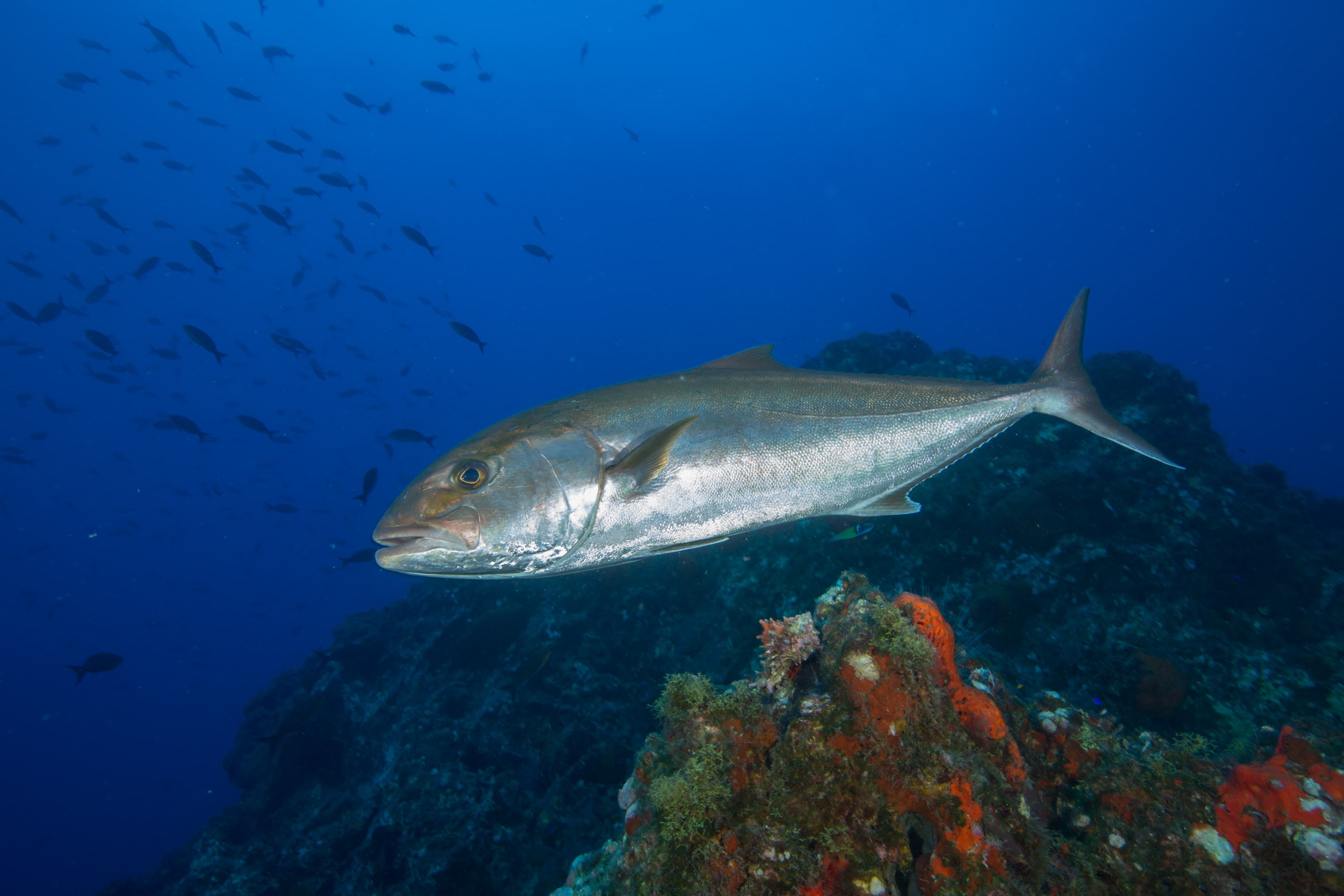
The bully of the Texas rigs. Western Gulf amberjack run bigger than anywhere else in the Gulf, often 60–100 lb, and they live all year on the platforms, reefed rigs, wrecks and natural banks from about 150 ft out to the shelf edge. The federal harvest season is short (September into October), but catch-and-release amberjack fishing is open all year and is some of the hardest pulling you'll do offshore.
October: PeakSeason closed Oct 14 in 2026; the fishing stays good for catch and release.
Texas and federal rules · Checked Oct 22, 2026
- Daily bag
- 1 per day
- Size
- 38 in total length (Texas) · 34 in fork length (federal)
- Season
- Federal: Sep 1 – Oct 13, 2026; closed until Sep 1, 2027
Texas state waters are open with the state limits, but federally permitted for-hire boats can't keep amberjack in state waters while federal waters are closed. Lesser amberjack and banded rudderfish have their own federal 14–22 in fork-length slot. Non-stainless circle hooks with natural bait and a dehooking device aboard in federal waters; a venting tool or rigged descending device for reef fish showing barotrauma (Texas state waters and, under the DESCEND Act, federal waters). Texas license with saltwater endorsement to land fish from state or federal waters.
Check the current rules ↗At a glance
- Best depth
- 250–350 ft; usually 150 ft or deeper
- Best structure
- Steel wrecks, standing rigs and cutoffs
- In the water
- 30–100 ft above the structure, on the outside edges
- Top bait
- Live blue runners (hardtails), then pinfish
- Water temp
- Above about 70 °F; seen to 65 °F
How to identify them
- A dark olive-amber stripe runs from the first dorsal fin through the eye to the snout (the "nuchal" bar), darkest when the fish is excited.
- Upper jaw curves up toward the eye; the body is long and powerful with an amber stripe along the side.
- Lesser amberjack: the stripe stops at the eye and they top out around 10 lb. Almaco jack: deeper, rounder body with a very long front lobe on the second dorsal fin. Banded rudderfish: white-tipped tail.
Month by month
- JanGoodOn the deep rigs all winter; catch and release only. Short weather windows.
- FebGoodSame; colder surface water pushes them deeper on the structure.
- MarGoodSpawning groups start gathering on shelf-edge structure.
- AprPeakSpring spawning aggregations of tens to hundreds on the deep rigs and banks (Mar–May).
- MayPeakBig fish on the 250–350 ft rigs; release them with a descending device.
- JunPeakMore fish at the platforms in summer; best early and late.
- JulPeakSummer: when the surface is hot they go deeper on the structure rather than leave.
- AugPeakSame; heavy tackle and short fights in the heat.
- SepPeakFederal season opens Sep 1: 1 fish, 34 in fork length. The busiest month on the AJ rigs.
- OctPeakSeason closed Oct 14 in 2026; the fishing stays good for catch and release.
- NovGoodFronts start cooling the water; the deep structure still holds fish.
- DecGoodWinter pattern on the deepest rigs and wrecks.
Where to find them
Depth
TPWD's biologists say you usually need 150 ft of water or more, and Texas captains rarely find amberjack consistently shallower than about 160 ft, though they show up as shallow as 60 ft. Out of Port Mansfield the best fishing is around 300–350 ft about 50 miles out; Freeport boats fish live bottom in 170–300 ft.
Structure, best first
Steel-hulled wrecks (Liberty ships, the Texas Clipper, sunken shrimp boats), then standing rigs and cutoffs, then reefed rigs (a toppled rig can sit up to ~100 yd off its posted mark), then natural banks and live bottom. If a spot holds vermilion it almost always holds amberjack.
Where they hold
Usually 30–100 ft above the structure, orbiting the outside edges. Around a platform they thin out to open-water levels about 50 m (160 ft) from the legs (BOEM study). Individual fish stay on the same reef for one to three months, so a good rig stays good.
The Flower Gardens
The Flower Garden Banks (about 115 mi off Galveston, 200–400 ft around peaks that rise to within ~65 ft) also hold amberjack, but sanctuary rules apply: hook and line only, no anchoring.
Texas spots to try
| Spot | From | Depth |
|---|---|---|
| High Island-A reefed rigs (A-341, A-349, A-355, A-567, A-570, A-571) | Galveston, 74–116 nm | 254–305 ft |
| Sunrise rig | Freeport | ~350 ft |
| Galveston-A-125 Reef | Freeport, 51 nm | 166 ft |
| Freeport Liberty Ship Reef (GA-A-22) | Freeport, 32 nm | 102 ft |
| Matagorda Island-A-7 / Brazos-A-132 | Port O'Connor, 37–40 nm | 198–200 ft |
| Mustang Island-A-85 ("Baker rig") / A-16 | Port Aransas | 273–274 ft |
| Mustang Island-828 Reef | Port Aransas, 27 nm | 165 ft |
| North Padre Island-A-58 / A-72 | Port Mansfield, 33–35 nm | 254 ft |
| Texas Clipper | Port Isabel, 23 nm (17 nm off South Padre) | 132–134 ft (top ~50 ft down) |
| Port Mansfield rock piles and shrimp-boat wrecks | Port Mansfield, ~30 mi | ~150 ft |
TPWD artificial reef positions; distances in nautical miles. The Offshore map scores these and every standing platform for the day's conditions.
How to catch them
Live bait, step by step
Catch hardtails (blue runners) at the rig and keep them lively. Set up so the bait starts well off the structure and high in the water, with the lightest sinker that holds. Drop half to three-quarters of the way down; if nothing happens, move up 30–50 ft, then work closer to the structure. Starting high and off the rig lets you turn a fish before it reaches the legs.
Winning the first seconds
When a fish eats, come tight hard and lift. On a standing rig, back the boat away at the hookup; on a cutoff, don't give an inch or it's in the steel. Hooked amberjack bring the school up with them, so keep a pitch bait ready for the followers.
Jigging
Butterfly or knife jigs worked fast through the school are Plan B when bait won't work, and on some days the fastest way to cover many rigs. Size the jig to the depth: about 1 g per ft of water (a 250 ft rig takes ~250 g), heavier in wind or current. Bucktails of 3–6 oz work when fish are up high. Two drops with no bite: move.
Tackle
80–100 lb stand-up rod of 6 ft or shorter, a 30-wide reel with 60–80 lb mono or 80–150 lb braid, 25 lb+ of drag, 3–12 ft of 80–250 lb leader and a 12/0–14/0 non-stainless circle hook (required with natural bait in federal waters). Put the 8–18 oz sinker on a ~40 lb breakaway loop near heavy structure, so a snagged weight breaks off instead of the whole rig.
Reading the conditions
Season
Year-round on the rigs, with more fish at platforms in summer and spawning gatherings on the shelf-edge structure in March–May. Harvest only in the federal September–October season.
Water temperature
They prefer water above about 70 °F (seen to 65 °F). When the surface gets hot they go deeper on the structure rather than leave.
Current
Moving water is fine; use the lightest weight that holds. Very strong current makes it hard to stay on the structure.
Barracuda and sharks
If barracuda hit the live baits, move ~100 yd off and troll hardtails on a downrigger. If sharks show up, move to another rig: they'll take every fish you hook.
Tips from the water
- Start high and off the structure, then work in.
- Pitch a second bait to the fish that follow a hooked one.
- Two drops without a bite means move to the next rig.
- Mark toppled rigs on the sounder before you drop; the posted position can be 100 yd off.
- The stock is overfished: release fish carefully, and send them down on a descending device.
Common mistakes
- Dropping straight to the bottom: amberjack sit above the structure.
- Light drag and long fights near the legs.
- Keeping a fish out of season or a lesser amberjack you thought was a greater (check the eye stripe).
- Staying on a rig after sharks show up.
Handling and release
Use a dehooker and a descending device: in a Gulf study, sharks took fish released at the surface on the way down but none sent down on a descender. Big amberjack are tough to hold; keep them in the water for photos when releasing. Fish over about 40 in are better released; smaller keepers eat better and carry fewer worms.
Use it today
- Best greater amberjack spots right now
- How to find fish offshore
- Conditions and Gulf seas today
- Moon & weather
- Fishing reports
By port: Sabine · Bolivar · Galveston · Freeport · Sargent · Matagorda · Port O'Connor · Rockport · Port Aransas · Corpus Christi · Port Mansfield · South Padre
Sources (12)
- TPWD: Amberjack bag and length limits (2026–27)
- NOAA Fisheries: 2026 Gulf greater amberjack season
- Texas Saltwater Fishing Magazine: Bring on the rig donkeys
- Texas Saltwater Fishing Magazine: The art of amberjacking
- Texas Fish & Game: Amber-jacked
- TPWD: Greater amberjack species profile
- TPWD: Texas Clipper reef
- BOEM: Fish distribution around platforms
- SEDAR 33: Gulf greater amberjack age, growth and maturity
- Mississippi State Extension: Descending devices and sharks
- Gulf Council: The other jacks and how to identify them
- NOAA: Flower Garden Banks regulations
Other species
Regulations change: confirm bag and size limits in the TPWD Outdoor Annual and with NOAA Fisheries (federal waters) before you keep a fish. Not for navigation.