Red snapper
Lutjanus campechanus · Snapper, sows (the big ones); "rubies" on the rigs
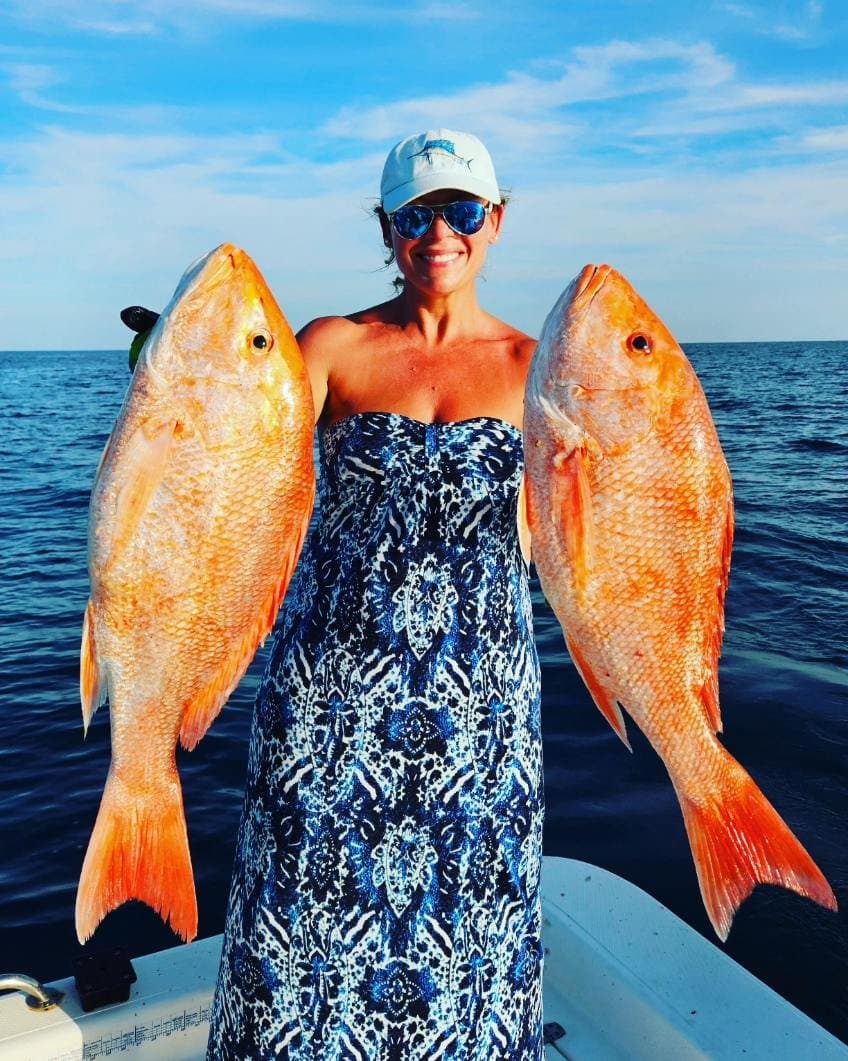
The backbone of Texas offshore fishing. Roughly 22–23 million red snapper live off Texas, from rock piles a few miles off the beach to the deep rigs and natural banks 100 miles out. Texas state waters (out to 9 nautical miles) are open all year, so with the right spot and rig you can catch snapper in any month, and the biggest fish of the year often come in the cooler months when the boats thin out.
October: PeakBigger fish and little pressure, especially on the Port Mansfield rocks; check whether federal waters are still open.
Texas and federal rules · Checked Oct 22, 2026
- Daily bag
- State waters 4 · federal 2 (counts toward the 4)
- Size
- 15 in state waters · 16 in federal
- Season
- State waters all year; federal (private) opened May 22, 2026, closes when TPWD's quota is reached
For-hire boats in federal waters: Jun 1 – Oct 25, 2026. The 2025 federal season closed Nov 21. Circle hooks with natural bait in state waters. Non-stainless circle hooks with natural bait and a dehooking device aboard in federal waters; a venting tool or rigged descending device for reef fish showing barotrauma (Texas state waters and, under the DESCEND Act, federal waters). Texas license with saltwater endorsement to land fish from state or federal waters.
Check the current rules ↗At a glance
- Best depth
- 50–200 ft; rarely shallower than 30–40 ft
- Best structure
- Natural banks, then rigs, reefed rigs and Liberty ships
- Big fish
- Deeper sites, and higher in the water column
- Hook
- 11/0 circle all-round; 8/0 shallow; 15/0 for the biggest
- Water temp
- Active until it drops below about 60 °F
How to identify them
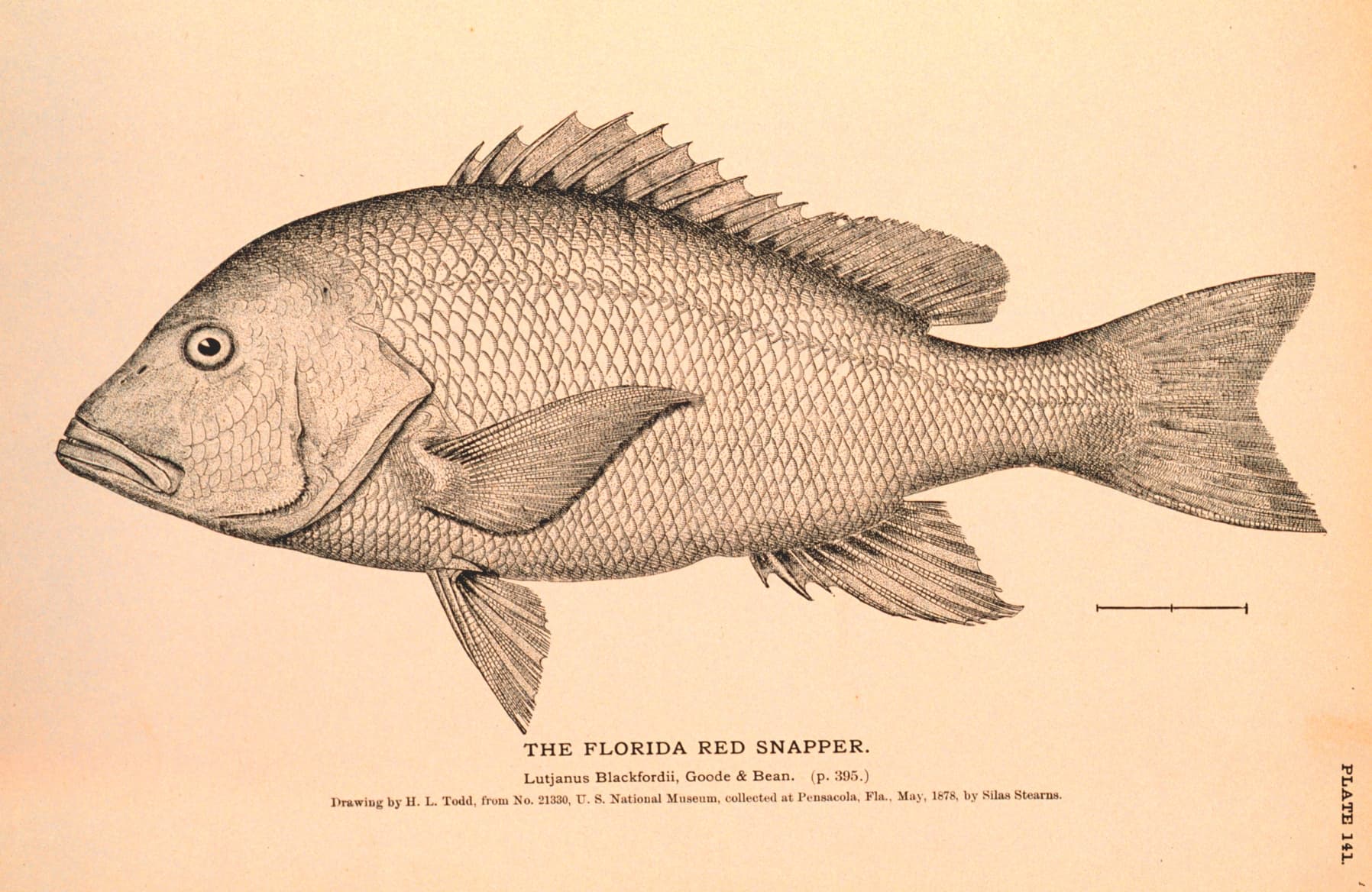
- Rosy red all over, paler on the belly, with a red eye; the body is deep and the head comes to a pointed, triangular snout.
- Young fish have a dark spot on the upper side below the soft dorsal fin; it fades as they grow.
- Vermilion snapper (beeliners) are slimmer, brighter orange-red, with thin blue-gold lines along the upper sides and a more forked tail.
- Lane snapper are smaller, pinker, with yellow stripes and a black spot near the tail.
Month by month
- JanGoodState-water rocks, reefs and wrecks in 40–80 ft between fronts; fish sit tight to the structure, near the bottom.
- FebGoodSame winter pattern: anchor or spot-lock on small structure; midday can beat early morning.
- MarGoodWater starts warming; nearshore reefs and Liberty ships; first calm windows to the 100-ft rigs.
- AprGoodSpawning begins on nearshore structure in 65–130 ft; state waters only for keeping fish.
- MayPeakFederal private season opened May 22 in 2026; rigs and reefs 20–40 mi out. Busy weekends.
- JunPeakPeak spawning month. Every rig, reefed rig and Liberty ship holds fish; for-hire season opens June 1.
- JulPeakSummer pattern: start where they mark high; watch for low-oxygen bottom water off the Brazos in hot, fresh years.
- AugPeakHot surface water: release fish fast and descend them; summer releases die about five times as often.
- SepPeakFish spread back over the banks and rigs; fewer boats once school starts.
- OctPeakBigger fish and little pressure, especially on the Port Mansfield rocks; check whether federal waters are still open.
- NovPeakPrime for big fish between fronts; the federal season often closes this month (2025: Nov 21).
- DecGoodWinter state-water snapper: 40–80 ft rocks, wrecks and reefs, heavier weights in current.
What 44 years of shelf surveys show
Every summer and fall since 1982, NOAA and the Gulf states' SEAMAP survey has towed the same kind of trawl across the shelf off Texas and western Louisiana. These charts are what 12,537 of those tows caught. Trawls work open, soft bottom, not the rigs and banks, and catch mostly smaller fish, so they show where along the shelf and at what depth red snapper are common, not what's on a given rig.
Survey tows
12,537
1982–2025, summer and fall
Tows that caught red snapper
53%
6,704 tows
Most per tow
120–180 ft
0.26 kg per hectare towed
Catch by depth
Average kilograms per hectare towed, all years. Hover or tab to a depth band for the number of tows.
- 0–60 ft0.03 kg/ha
- 60–120 ft0.12 kg/ha
- 120–180 ft0.26 kg/ha
- 180–240 ft0.22 kg/ha
- 240–300 ft0.15 kg/ha
- 300–400 ft0.22 kg/ha
Show the numbers
| Depth | kg per hectare | Tows | Tows with red snapper |
|---|---|---|---|
| 0–60 ft | 0.03 | 2,427 | 573 |
| 60–120 ft | 0.12 | 4,841 | 3,023 |
| 120–180 ft | 0.26 | 2,281 | 1,781 |
| 180–240 ft | 0.22 | 1,570 | 944 |
| 240–300 ft | 0.15 | 1,080 | 328 |
| 300–400 ft | 0.22 | 327 | 54 |
Year by year
Average kilograms per hectare towed each year. The last ten years averaged about 2.8 times the first ten.
Show the numbers
| Year | kg per hectare |
|---|---|
| 1982 | 0.50 |
| 1983 | 0.32 |
| 1984 | 0.14 |
| 1985 | 0.05 |
| 1986 | 0.07 |
| 1987 | 0.05 |
| 1988 | 0.04 |
| 1989 | 0.05 |
| 1990 | 0.12 |
| 1991 | 0.08 |
| 1992 | 0.05 |
| 1993 | 0.08 |
| 1994 | 0.10 |
| 1995 | 0.14 |
| 1996 | 0.11 |
| 1997 | 0.09 |
| 1998 | 0.06 |
| 1999 | 0.09 |
| 2000 | 0.08 |
| 2001 | 0.11 |
| 2002 | 0.08 |
| 2003 | 0.08 |
| 2004 | 0.17 |
| 2005 | 0.17 |
| 2006 | 0.08 |
| 2007 | 0.09 |
| 2008 | 0.09 |
| 2009 | 0.13 |
| 2010 | 0.17 |
| 2011 | 0.23 |
| 2012 | 0.26 |
| 2013 | 0.23 |
| 2014 | 0.20 |
| 2015 | 0.35 |
| 2016 | 0.35 |
| 2017 | 0.32 |
| 2018 | 0.47 |
| 2019 | 0.42 |
| 2020 | 0.40 |
| 2021 | 0.33 |
| 2022 | 0.39 |
| 2023 | 0.44 |
| 2024 | 0.39 |
| 2025 | 0.46 |
On the Offshore map, the Survey biomass overlay shows each 0.1° patch of shelf against other water of the same depth, and the same survey nudges the red snapper scores. Data: SEAMAP Gulf groundfish trawl survey, Gulf States Marine Fisheries Commission.
Where to find them
Depth by season and size
Most Texas snapper fishing happens in 50–200 ft. Freeport boats work 80–200 ft at 20–40 miles, Galveston trips run 40–50 miles, and the Port Mansfield rocks fish best in 48–96 ft. In winter the fish inside state waters hold in 40–80 ft. TPWD's vertical-longline survey (183 sites, 1,074 snapper) caught larger fish more often at deeper sites, and the biggest tended to hit the higher hooks. Small fish crowd the close, heavily fished spots inside about 30 miles.
Natural banks
Few but high relief, and they hold the most snapper biomass and the largest, oldest fish off Texas: catch rates ran 1.01 fish per drop-minute on natural banks against 0.61 on artificial reefs (Harte Research Institute / TAMU-CC). Claypile and Heald on the upper coast, Baker, Aransas, Hospital and Southern Banks off Port Aransas, and the Port Mansfield rocks.
Rigs, reefed rigs and Liberty ships
Most Texas artificial reefs are decommissioned rigs (Rigs-to-Reefs). Snapper stay close to them. The Liberty ship reefs off Freeport, Port O'Connor, Port Aransas and Port Mansfield sit in about 100–110 ft and are the classic close-in trip.
Small hard spots and open bottom
More than 95% of the Texas seabed is open bottom, and the Great Red Snapper Count found a larger share of the big fish there. Wellheads, junk piles and hard spots only 2–10 ft across get little pressure and can out-fish the rigs. The Hi-res bottom layer on the Offshore map shows where to look.
Texas spots to try
| Spot | From | Depth |
|---|---|---|
| Mitchell's and Barr's Reefs | Galveston, 11–12 nm | 57–60 ft |
| Freeport Liberty Ship Reef | Freeport, 32 nm | 102 ft |
| Freeport Rocks | About 12 nm south of Freeport | 43–79 ft |
| Claypile Bank and Heald Bank | Upper coast | Claypile 82–98 ft crest; Heald 30–46 ft |
| Galveston-A-125 / High Island-A rig reefs | Freeport / Galveston, 51–116 nm | 155–305 ft |
| Matagorda Island Liberty Ship | Port O'Connor, 21 nm | 107 ft |
| Brazos-A-132 | Port O'Connor, 40 nm | 200 ft |
| Boatmen's and Lonestar Reefs | Port Aransas, 6–10 nm (state waters) | 60–72 ft |
| Mustang Island Liberty Ship / MU-828 | Port Aransas, 18–27 nm | 110–165 ft |
| Baker, Aransas, Hospital and Southern Banks | Port Aransas, ~30–35 mi | crests ~180–220 ft |
| Port Mansfield rocks and Liberty ship | Port Mansfield, a few to 15 nm | 48–102 ft |
| Port Isabel Reef | Santiago Pass, 7 nm (state waters) | 75 ft |
TPWD artificial reef list (2003; more rig reefs have been added since) and Texas bank studies. The Offshore map scores these and every standing platform for the day.
How to catch them
On the rigs, reefs and wrecks
Drift or spot-lock 50–100 yd off a platform, past the triggerfish, and work every side; the up-current side usually holds the stronger fish unless the current is very weak. If they mark high on the sounder (40 ft down, say), start there: the biggest fish are often highest. Arrive early ahead of other boats, and move after a few drops if you only catch small fish.
Winter state-water snapper
November through March, inside 9 nm: rocks, reefs and wrecks in 40–80 ft. The fish sit tight to the structure near the bottom, so anchor or spot-lock right on it and use 6–10 oz weights in current. Fish the stable days between fronts; a falling barometer ahead of a front can spark a short flurry.
Baits
Keepers: cut pogies (menhaden), cigar minnows and squid (squid catches mostly small fish). Big "sow" snapper: live pinfish (4–6 in piggy perch), croaker, blue runners or Spanish sardines, or big slabs of cut bait. A 2 oz bucktail tipped with a cigar minnow or a 3–4 oz arrowhead jig works too. Chum with 1 in pieces of pogy or sardine, or a few whole frozen pogies, to pull fish up off the structure.
Rig and tackle
A Carolina (knocker) rig with the lightest egg sinker that reaches bottom: 1–4 oz in light current, 6–10 oz in winter, up to ~16 oz deep in strong current. Avoid double-drop rigs with a heavy bank sinker. Keepers: 20–30 lb mono or 40–50 lb braid with 40–60 lb fluorocarbon and an 8/0–11/0 circle. Sows: 80–100 lb braid, 80–130 lb leader (150–250 lb for fish over 25 lb) and an 11/0–15/0 circle. Bigger hooks caught bigger fish at every depth in TPWD's survey.
Reading the conditions
Water temperature
Water from Freeport to Port Mansfield usually stays 60–80 °F in winter and snapper stay active until it drops below about 60 °F. In summer the surface can pass 86 °F over a sharp thermocline, which makes releases deadly.
Current
In light current, chum and light weights work in 50 ft. In strong current, drift rather than anchor, or hold just down-current of a rig, and go heavier on the weight.
Low oxygen
Freshwater runoff can leave a low-oxygen layer right on the bottom in summer (off the Brazos and San Luis Pass to Matagorda Bay, about 30–35 miles out in 2007). If a usually good spot is dead or the fish suspend high, try another depth.
Weather windows
Most snapper trips are 20–60 miles, so seas decide the day. The Offshore map rates each spot's run as go, marginal or no-go from the wind forecast.
Tips from the water
- Start fishing at the depth they mark, not at the bottom.
- Bigger hooks and live baits pick out bigger fish; squid feeds the small ones.
- Small, quiet hard spots away from the rigs often hold the better fish.
- In federal waters, know whether the private-angler season is still open before you keep a fish; Texas announces the closure date when the quota is close.
- Keep a descending device rigged on a rod before you start, not in a drawer.
Common mistakes
- Anchoring right on top of a busy rig and fishing through the triggerfish.
- Staying on a spot that only gives up throwbacks.
- Venting through the stomach that's pushed out of the mouth (vent behind the pectoral fin, or better, descend the fish).
- Heavy bank sinkers on double-drop rigs: they snag and spook the bigger fish.
Handling and release
Snapper pulled from deep water get barotrauma (a swollen swim bladder). In a Texas study off Port Aransas, 80% survived when sent back down on a descending device, 75% when vented and 59% when simply tossed back; survival was 88% from 100 ft and 65% from 165 ft. Clip the fish by the lip and drop it back toward the bottom, use a dehooker, and be quick, especially in summer.
Use it today
- Best red snapper spots right now
- How to find fish offshore
- Conditions and Gulf seas today
- Moon & weather
- Fishing reports
By port: Sabine · Bolivar · Galveston · Freeport · Sargent · Matagorda · Port O'Connor · Rockport · Port Aransas · Corpus Christi · Port Mansfield · South Padre
Sources (12)
- TPWD: Snapper bag and length limits (2026–27)
- TPWD news: 2026 federal red snapper season opens May 22
- Gulf Council: Texas federal red snapper season closes Nov 21 (2025)
- NOAA Fisheries: 2026 Gulf red snapper for-hire season
- TPWD field notes: Texas-sized red snapper (survey: depth, hook size)
- TPWD: Red snapper brochure
- Texas Saltwater Fishing Magazine: Rubies on reefs, wrecks and rigs
- Texas Fish & Game: Targeting Texas winter red snapper
- Gulf Council SSC: Great Red Snapper Count, Texas habitat
- GCFI: Red snapper across habitat types in the NW Gulf
- Gulf hypoxia: Dead zone off the Texas coast (2007)
- TPWD: Texas artificial reefs (2003 list)
Other species
Regulations change: confirm bag and size limits in the TPWD Outdoor Annual and with NOAA Fisheries (federal waters) before you keep a fish. Not for navigation.